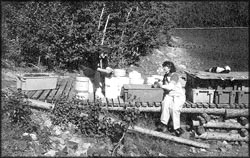
 Denyse sorts mussel seeds with her sister Deann |
|
Department of Fisheries put us in contact with a company called Atlantic Ocean Farms - they're from Cottrell's Cove. So we went and spent the day with them. They farm and process mussels. After the trip we decided, okay, this is what we're going to do. We went back home and everything was set in motion. We said we'll move back to Springdale, which is a seafront. That meant we would have to sell our home, pack up the kids, and sell the trucks. Actually we kept one truck. My husband trucked until November and then took the Long Line Mussel Culture Course at the Marine Institute in St. John's. We started with Salt Water Pond in 1988. That summer we spent four weeks living there in a tent. I don't know why, but every time I came to the area, it was like I we. coming home, it was so nice, so peaceful. I'd get there and wouldn't want to leave. My father was adopted, and when I did some research on his side of the family a couple of years ago, I found out that his mother was born and raised in Little Ward's Harbour, where we started our first farm. At one point there was almost 100 people living there. The graveyard is up on the hill and the gravestones are still there. One dates back to the late 1700's. Cultured mussels start with a wild mussel that spawns 25 million eggs. That larvae is floating in the water for about three weeks, just floating in the tide. You can't see it. At the end of three weeks it has to land somewhere and grow. So what we're doing is providing the place for it to land and grow. In Newfoundland we use what they call long line mussel culture, same as Prince Edward Island and the rest of Atlantic Canada. |