Spelling
Sometimes, the biggest issue is a learner's own fear of making mistakes.
Encouraging learners to take risks is important in learning a language and
spelling is no exception.
Some strategies that your learner may use include:
- Start by trying to write down the first letter of the word.
- Put down any other familiar letters in the word.
- Break the word into syllables for other possible clues.
- Think of rhyming words your learner knows how to spell (i.e.
if your learner needs to spell,
"Frank" you could brainstorm
other words such as bank, tank).
- Read back what she has written thus far (to see what the word
now sounds like).
- Ask someone for help.
- Use a dictionary.
Some learners may prefer to learn how to spell a word using visual
stimuli - by seeing the word in print, closing their eyes, trying to remember how
to spell it and then checking the original word to ensure that it
is spelt correctly. Other learners would prefer to write the new word out several
times to help them remember. Some learners would rather take a more
analytical approach and attack the spelling of the prefix, the base word
and the suffix separately.
A: Spelling Activities 1
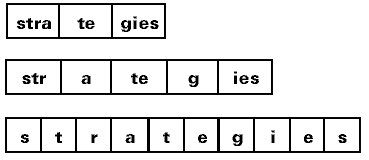
1. Word Jigsaws
By cutting a word into smaller pieces and having the learner put
it in the right order, we can give the learner additional opportunities
to practice spelling.
1 Jill Bell and B. Burnaby, A Handbook for ESL Literacy. (Toronto,
Ontario: The Ontario Institute for Studies in Education, 1984.)
|