More Newfoundland and Labrador women were candidates in the past three elections than during any other time in our history. Lady Helena Squires was the first woman ever elected to the Newfoundland Legislature in 1930. History Grace Sparkes was the Progressive Conservative (PC) candidate for Burin in the 1949 and 1951 elections. She was not elected but she has been a role model for women in Newfoundland politics. In 1975, St. George's District Liberal candidate Hazel McIsaac was the first woman elected to the House of Assembly after Confederation. Four women ran when Hazel McIsaac was elected in 1975. There were four provincial elections in the twenty years between 1951 and 1971. No women candidates ran. Fifteen women ran in different districts in 1979. Ten ran for the New Democratic Party (NDP). The five provincial elections between 1979 and 1989 saw two women elected in four elections and one in the other. Women came on strong in the past three elections with 28 running in 1993, 22 in 1996, and 28 in 1999. Elections held before 1996 had more NDP women candidates than women in the other parties. The past two elections saw a change with more women running for the two leading parties. What is needed? "The first woman to get elected broke the ground," said Luanne Leamon, Department of Education Assistant Deputy Minister for Literacy. "Once a few pioneers get through that makes it possible for other women. Lynn Verge and Hazel Newhook were very popular. The first women to break through gave the okay." Provincial PC Party Leader Ed Byrne says his party made a special effort to find women who were interested in running in the last election. His party wanted to give the women a chance to run. They were "prepared to level the playing field" in providing help such as financial help for childcare to those women who needed it. "I felt it was very important not only to say we wanted women to run but to entice them to run," said Mr. Byrne Helen Porter, Hazel Newhook, and Lynn Verge are pioneers in Newfoundland provincial politics. Helen Fogwill Porter
Helen is a writer living in St. John's. She started writing seriously in the 1960's. She wrote a memoir/history called Below the Bridge. Now, she is writing a sequel to her last novel. In 1997 she received an honorary degree from Memorial University. She said her political experience "has given me more confidence." Hazel Newhook
She was Minister of Consumer Affairs and Environment for a year. Then she became Minister of Municipal Affairs and Housing. She was Mayor of Gander before getting into provincial politics. . Ms. Newhook says that her dealings with the people in Gander when she worked at her family's business made it easier for her when she got into politics. "Most women in politics have had good experiences and held good jobs. If you have not proven yourself in some way you cannot expect people to vote for you," she said. "Women have to become involved in community life. They have to prove they can take an office, be chairpersons, and be good workers. People have to know you." Ms. Newhook says women may find it hard to run for elections because it takes time from the family. When you are serving your district you have to attend different events. "Government comes before family," she said. Politics was a wonderful experience for her. She has good memories from that time. Lynn Verge
Ms. Verge was one of the first members of the Corner Brook Status of Women's Council. She was involved in women's and family issues. As a lawyer, she saw that women's needs were not being addressed. She worked for changes to the matrimonial property act. Changes came about in 1980. "I wanted the provincial government to make decisions to improve laws for women so the public as a whole would be better," she said. Ms. Verge was involved with the women's groups and encouraged women to run for hospital boards and school boards. In 1979 she was trying to get women to run in Humber East and finally they said, "why don't you run?" She was 28 years old when she won her first election. "Women in general seem to expect more of themselves than men do. I have been amazed more than once when a man would jump at the chance to run and a more qualified woman would not," she said. It may have to do with role models. Men have lots of male role models in politics. Ms. Verge says most of her political role models were older men. Later on she looked to women such as Hazel McIsaac, Dorothy Wyatt, and Helen Porter. She met federal politicians like Flora McDonald and Judy Lemarsh. Ms. Verge says that she feels good about helping bring about the reorganized high school program when she was Education Minister. The program added more Newfoundland and Labrador course content. Also, children with disabilities were integrated into the schools. She says, ideally, a cabinet is made up of young and older men and women. Her advice to women who are thinking about running for politics is to "Be true to themselves. Do not copy others." "Politics has been a vocation, a full time job for 17 years. It is also my passion. It is something I did even when socializing," she said. "It made my life much richer than it would have been." Where are we now Women have come a long way in recent years. There are more women role models now and present party leaders have tried to get more women involved as candidates. "Things are changing but they cannot change overnight," says Mr. Byrne. "If those gaps are still present we have not come very far really. I tell my daughter she can do and be anything she wants to do or be", he said.
|


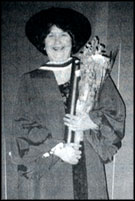 Helen Fogwill Porter ran as a New
Democratic Party (NDP) candidate three times for Mount Pearl (1975, 1979,
1982), and for Harbour Grace in 1985. She was not elected. She was always
interested in politics, even as a child. She worked for the NDP Party before
and after she ran as a candidate. Helen said when she ran the NDP was a newer
party and they were not so set in their ways. She ran at the beginning of the
women's movement. Her role model was Julia Salter Earle who ran for St. John's
city council in 1925. She said Ms. Earle worked outside the home and was always
involved in things. At that time women stayed home. Helen said it is important
for girls to see women in leadership roles. It seems more is expected from
women. "We want to get to a point where people don't even think about it
any more (whether it is a male or female candidate)," she said.
Helen Fogwill Porter ran as a New
Democratic Party (NDP) candidate three times for Mount Pearl (1975, 1979,
1982), and for Harbour Grace in 1985. She was not elected. She was always
interested in politics, even as a child. She worked for the NDP Party before
and after she ran as a candidate. Helen said when she ran the NDP was a newer
party and they were not so set in their ways. She ran at the beginning of the
women's movement. Her role model was Julia Salter Earle who ran for St. John's
city council in 1925. She said Ms. Earle worked outside the home and was always
involved in things. At that time women stayed home. Helen said it is important
for girls to see women in leadership roles. It seems more is expected from
women. "We want to get to a point where people don't even think about it
any more (whether it is a male or female candidate)," she said. Hazel Newhook ran as the Gander
District PC candidate in the 1979 election. She won and became one of the first
two female cabinet ministers in Newfoundland history. She was defeated in both
the 1982 and 1985 elections.
Hazel Newhook ran as the Gander
District PC candidate in the 1979 election. She won and became one of the first
two female cabinet ministers in Newfoundland history. She was defeated in both
the 1982 and 1985 elections. Lynn Verge spent 17 years in provincial
politics. She was one of the first women cabinet ministers. She was first
elected as the PC candidate in Humber East in 1979 and ran in five other
elections. She was Education Minister and later in 1989 became Minister of
Consumer Affairs and Communication for a short time.
Lynn Verge spent 17 years in provincial
politics. She was one of the first women cabinet ministers. She was first
elected as the PC candidate in Humber East in 1979 and ran in five other
elections. She was Education Minister and later in 1989 became Minister of
Consumer Affairs and Communication for a short time. |
 |
 |