|
A local company will host a pilot project to test the applicability and effectiveness of a literacy model, which if successful, could become the model used in rural communities across the country. The project, coordinated by the Random North Development Assoc. (RADA), received funding commitments from the Labour Market Development Agreement ($334,455) and the Canada-Newfoundland Comprehensive Economic Development Agreement ($45,000). On hand for the announcement were: The Honourable Fred J. Mifflin, Minister of Veterans Affairs and Secretary of State to the Atlantic Canada Opportunities Agency (ACOA), on behalf of the Honourable Pierre S. Pettigrew, Minister of Human Resources Development Canada; Mr. Doug Oldford, MHA for Trinity North, on behalf of the provincial government; Mr. Clarence Williams, president, RNDA; and Michelle Brown, project coordinator with RNDA. 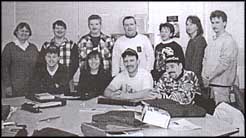
The project, "Linking Adults with Limited Literary Skills to Skills Training and Employment Opportunities," will work in partnership with Atlantic Marine Products Ltd. Ten participants were chosen for the project from which they will gain literacy skills related to employment at the facility. If the project is successful, the model will be adapted for use in other rural areas. "The federal government remains committed to exploring the various avenues available to increase literacy rates in rural areas as a means to increasing employment opportunities," said Minister Mifflin. "This project is an excellent example of a rural development group seeking out opportunities to further develop human resources in the area with an extra benefit of creating job opportunities and testing a literacy model with far-reaching literacy and employment benefits." Mr. Oldford agrees that the results of this literacy pilot project could have significant practical applications for other rural areas where the literacy rate has been identified as a barrier to employment and economic development. "By combining on-the-job training with improving academic skills, this approach may help employers and potential employees overcome such barriers This approach not only matches training initiatives to the needs and capabilities of employees, but addresses the skills identified by industry. It also complements the goals of the Discovery Regional Economic Development Board to increase the literacy rate throughout the region." According to Mr. Williams, this pilot project arose out of the association's efforts to find new ways to deal with literacy problems in the area. "We recognize that traditional methods of addressing literacy problems, while valuable, are often 'hit and miss'. The theory behind this new model is to provide training that is focussed around the individual and directly linked to work placement. This pilot project will provide a refined model with a tested concrete example." The Labour Market Development Agreement (LMDA) is a co-managed agreement between the federal and provincial governments, administered by Human Resources Development Canada and Human Resources & Employment. The LMDA partners work closely with individuals, communities and other stakeholders to help clients meet measurable and achievable educational, employment and economic development goals. In addition, the LMDA partners work together in the design and management of Canada's employment benefits and support measures, ensuring they compliment Newfoundland and Labrador's labour market programs and services. The Canada-Newfoundland Comprehensive Economic Development Agreement is a federal-provincial initiative administered federally by ACOA and provincially by the Departments of Industry, Trade and Technology and Development and Rural Renewal. |
| For further information
contact: Randy Devine Atlantic Canada Opportunities Agency (709) 882-2935 Josephine Cheeseman Development and Rural Renewal (709) 729-4570 Michelle Brown Random North Development Assoc. (709) 466-1725 |