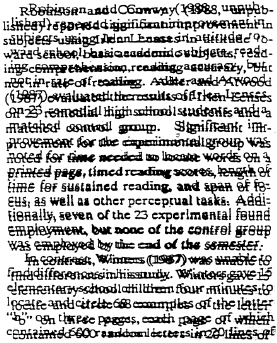
Figure 8.1 The ‘swirl effect’ – as reported in the Guardian newspaper 17th October 1995.
Not so many years ago the ‘swirl’ and ‘see-saw’ effects were widely reported and regarded as pathognomic for ‘dyslexia’. Oddly, they are not commonly reported any more. The story went like this. For some ‘dyslexics’ text appears to swirl so violently about as to be unreadable. Some report a ‘see-saw’ effect, where lines of text move wildly up and down such that nothing can be made of it. These appear to be genuinely experienced effects, once regarded as typical, even diagnostic, of dyslexia so let us have a look. For a swirl effect, for example, to be actual, one of only two things can be happening – either the visual system is distinguishing text from all other visual stimuli in order specifically to swirl only text around or to the unfortunate person everything swirls about. This latter is not reported and it would, of course, hardly be possible to live if it did. How can we otherwise explain the swirling of print? Could it be an affectively mediated effect? Is so much anxious stress associated with the intensely personal demands of print that it comes to feel as if it swirls, or jumps about, or is in some way inherently unreadable? It cannot, in an otherwise normally sighted individual, really be doing so. Is this an unconscious self-defence, transferring responsibility from the individual to his physiology? (and see Martin 1989 p. 53 reporting that when he has to play the piano in front of his teacher he sweats and freezes, and the notes seem to jump around on the page before him). Or Johnston: ‘In my view the effect of anxiety in reading difficulty cannot be over-estimated.’ (1985 p. 167).
The profound effect of affect (e.g. anxiety, or stress) on literacy has been described in the previous chapter. In their report on ‘'Dyslexia, literacy and psychological assessment' the British Psychological Society (1999) asserts that
Emotional difficulties can be associated with dyslexia. Whilst these affective responses are not the causes, but rather the consequences, of dyslexia they may contribute to, and exacerbate, learning difficulties in a complex and incremental way. (p. 45).