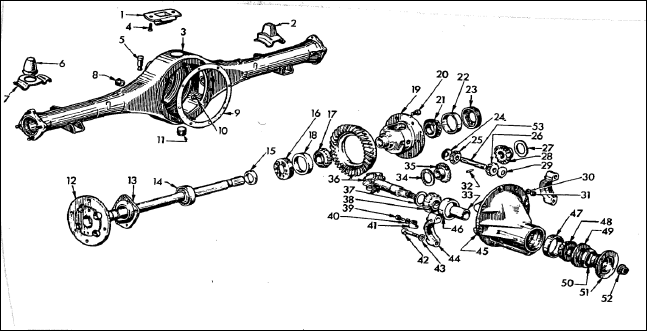
Exploded text.
Most skills are learned by people rather than being taught to them. Good teaching is ‘merely’ the provision of environments, both intellectual and affective, in which learning is maximally attractive and likely. This applies particularly to the learning of writing. Good writing is a non-derivative expression of free thought. Good writing is free and autonomous, individual and personal. The aim of tuition is good writing. This may entail not much more than setting out in metacognitively aware pursuit of the right goals. These include personal autonomy and the confident, free ownership of language; the confidence to have a go and the skills of surviving, and making good, imperfection; how to consider, criticise and correct writing; the properly enthusiastic use of the waste paper basket.
There is only one way autonomously to improve writing. It’s simply what we all do, in real life, all the time but, mindful of the importance of metacognition, we must openly formalise and teach the procedures and also the need to use them when we write. In the first instance it is crucial to redress the Matthew effect. ABE students who want to learn to write must do so in quantity. An ABE student needs the practice. The resulting writing will be the basis for learning how to self-correct and how to improve, using the language experience method. The skills in good writing range from the meta to the micro, from the assembly and display of wise, worldly and witty thoughts to the careful consideration of commas. It is, of course, impossible to teach this as a ‘subject’. It is only possible to learn how to write by doing some and then critically but positively examining the outcome. This is the language experience method, yet again. I use a method which I call ‘exploded text’ in order to formalise the processes inherent in this particular application of the general language experience approach; to make it more precisely metacognitively clear exactly what the method entails.
Figure 11.1 Rear axle: component parts
The above diagram is what an engineer calls an exploded view of a mechanism. All the bits are, in imagination, blown apart and then drawn. The viewer can, as a result, see very easily and clearly what each bit looks like, where it goes and what it does – what it is and where it fits in the greater scheme of things. What is sauce for engineers may be sauce also for educators. If we ‘explode’ a piece of writing both its general form and all its specific details become much more clearly visible.