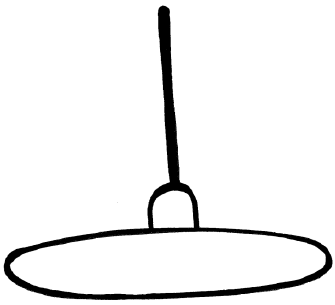
figure 4.2
Look at figure 4.2. It is a simple outline drawing. Read this sentence: ‘The weather was so hot that we invited the neighbours round for drinks and some snacks done on the barbecue.’ Stop reading, for a moment, and consider what the figure depicts. Perhaps you decided it was a sausage on a fork? Very possibly. Suppose, however, I had asked you to read another sentence before looking at the drawing: ‘John's father is in the navy.’ I believe you would have seen the drawing as a submarine and deduced that John’s dad served underwater. Clearly, we can be induced to ‘see’ according to mental context. The decision as to what is seen is driven, in part at least, by the concepts knocking around in the mind at the time. We can call this concept-driven or top-down processing. The mind, in top-down processing theory, is held to be applying an active search for meaning to all incoming data, to be seeking and applying hypotheses to it. This has one very beneficial effect, namely that we can make meaningful decisions very quickly and based on often rather partial or incomplete data, we can ‘see’ even if the information we get is sometimes incomplete or confused, so long as we have some idea beforehand (as we usually do in fact) as to what the information is likely to be about; so long as we can form a plausible hypothesis, in other words. We’ll get it wrong sometimes, but that’s a risk worth taking for the extra speed and flexibility we get by doing it this somewhat slapdash way.
‘Seeing’, then, is a variable mix of top-down and bottom-up processing, matching data being collected by the eyes with information activated in the mind itself in order to reach the most sensible decision as to what is to be seen as swiftly and economically as possible. How much top-down and how much bottom-up processing will be needed depends on a trade-off between how much relevant information we already have available in our mind as well the clarity of the data itself. Once stated, this is obvious and common experience; the more we already know the less we need to look for in order to ‘see’. We can put this slightly more technically: the more non-visual information we have (in our mind already) the less visual information (hard data) we need in order to decide what we have ‘seen’.
Reading is not a special visual activity - it is just like all other kinds of looking. It seeks only personally relevant meaning. When reading a thriller or romance you can whizz along at high speed, paying relatively little attention to the print itself, perhaps even deciding to skip swathes of it altogether, yet extracting quite detailed meaning from it very rapidly and very efficiently. You know, in advance, pretty well what is coming up - the only surprises will be exactly those surprises you expect from the genre. You bring quantities of non-visual information to the task and need correspondingly less visual information. Significantly, this kind of reading is often used as an escape, as relaxation or to kill time, when concentration is difficult and effort undesirable. These are the books you read on trains and in airport lounges. You do not read, in such places and for such reasons, heavy tomes on the effect on systems of government of changing patterns of mediaeval land ownership, the application of modern market research techniques to educational planning in the eastern bloc or the writing of programs for the assessment and management of fuel requirement in intermediate-distance rocketry. Such reading is much slower and much more demanding. You find yourself, when reading such heavy stuff, paying much closer attention to the print itself (the actual squiggles on the page) - you sometimes find yourself peering myopically, even fiercely at it. The work may be enjoyable, but it is recognisably work all the same and will tire your brain and your eyes. Your imperfect prior knowledge of the subject means that the amount of non-visual information you can bring to the task is limited and so the amount of visual information you must gather is correspondingly increased. You must examine the print far more closely than ever you did that in the thriller you read on the 17.35 out of Waterloo.