|
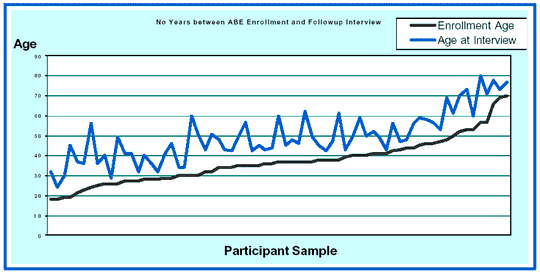
It is useful to have a “snapshot” of the overall group of individuals participating in this study, as age may play a part in their perceptions and provides a background against which they can measure their life expectations and accomplishments. For the most part, the participants in this study reflect individuals who have an experiential framework with which to respond since only two percent were below 30 years of age. With this in mind, age as well as gender will be used in some of the subsequent analyses. Participants ranged from 18 to 70 years of age at the time of their enrollment in ABLE classes and from 24 to 80 years of age at the time they were interviewed for this study. The shortest amo unt of time between program enrollment and study participation was two years; the longest span was 32 years; and the average span was 13 years. Chart III provides a graphic overview of the number of years between participants’ ages at ABE enrollment and their follow-up interviews. Range of Time between ABE Enrollment and Follow-up Interviews
The longitudinal study was carried out in the field by eight research assistants chosen according to the locality of participants. Priority in selection was given to Success Stories award recipients who were teachers or social workers or were working toward degrees in these fields. Two former award recipients met the criteria and were selected to work in the Philadelphia area and in the Northwestern region of Pennsylvania. Two retired adult education teachers, a retired program director, and a university-based ABLE researcher were selected to work in the Northeastern and Central regions. A former adult education state resource center associate and a former ABLE program director conducted interviews in the Pittsburgh and Erie areas. Training for participant/research assistants involved a one-on-one interview conducted by Dr. Royce prior to their field experience. Role playing a research assistant, Dr. Royce scheduled the interview, requested permission to tape, obtained signoff agreements, asked the open-ended questions, read and completed the Impact Survey and QOLI with the interviewees. There was a lengthy discussion of the interview protocol and prompt sheet as well as standard ways to administer the Impact Survey and Quality of Life Inventory. |
| Previous Page | Contents | Next Page |