| Assessing the Complexity of Literacy Tasks |
 |
|
The task is more difficult if the respondent has to identify the answer in a non-paradigmatic relationship such as that shown below. In this piece of text, the reader must identify the antecedent for the pronoun ‘these’ in the last sentence to arrive at a definition of CPP pension credits. Notice that the text does not even say that ‘these are your CPP pension credits” but rather “these become your CPP pension credits.” 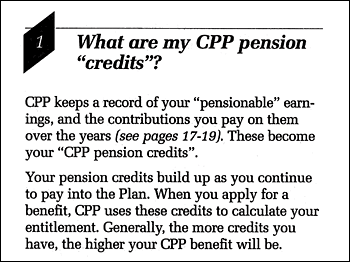
The given and requested information can also be related by a categorical relationship. If the directive calls for a form-filler to “list any pets living in your residence,” the respondent should have no difficulty identifying cats, dogs, and snakes as members of the ‘pet’ category. On the other hand, he or she would have more problems identifying what fits in the ‘income’ category if asked to “list any sources of income you may have.” Semantic cues are the basis for much inference during reading. A ‘semantic field,’ sometimes called a lexical field, is the usual meaningful context in which words appear. For example, ‘centimetre’ occurs in a semantic field that may include ‘metres,’ ‘litres,’ ‘milli,’ and ‘mega.’ ‘Mother,’ ‘brother,’ ‘son,’ ‘daughter’ are in the same semantic field, but the terms ‘female parent,’ ‘sibling,’ ‘male offspring’ are in another. The most significant thing we can say about semantic fields is that they influence the kind of predictions and inferences we make. We automatically fill in the missing units on speed limit signs because we are aware of which unit is relevant on the highway (kilometres per hour). If the first entry in a recipe is ‘2 cups of flour’ we are able to anticipate that ingredients such as pepper and salt will be measured in teaspoons and tablespoons; if the first entry is 1 litre of milk, then we anticipate that ingredients such as pepper will appear in millilitres. In some information exchanges, differing semantic fields are readily apparent. Imagine the customs agent at the border asking ‘How long have you been out of the country?’ to a returning Canadian couple. His viewpoint is regulatory and he wants an answer in hours. Their response is “all weekend,” or “a couple of days,” reflecting a more recreational framework where time is hardly noted at all. |
 |
||
| Previous page | Table of contents | Next page |