| Assessing the Complexity of Literacy Tasks |
 |
|
Quantitative Complexity Factors Like prose and document processing, quantitative tasks require the identification of given and requested information, the matching of phrases and features, and the avoidance of distractors. Added to these complexity factors are two others that apply only to quantitative tasks–‘type of calculation’ and ‘operational specificity.’ Type of Operation Type of operation refers to the actual arithmetic operation that must be carried out as part of the literacy task. In general, addition is easier than subtraction; multiplication is easier than division. Single arithmetic operations are always easier than combinations of more than one operation. For the purposes of rating ‘type of calculation’ the following values can be used:
In the example shown below, a section of a pension workbook, the respondent is asked to carry out several addition and multiplication steps to complete the pension calculation; however, for the purpose of analysis, each instruction can be identified as a single operation, and should be. The multiplication operations in steps 3 and 4 are more difficult than the addition in step 5. The ‘calculation’ referred to in step 2 is not well specified, but involves converting ‘years’ to months. As you will see in the next section, lack of ‘specificity’ makes quantitative tasks more difficult. 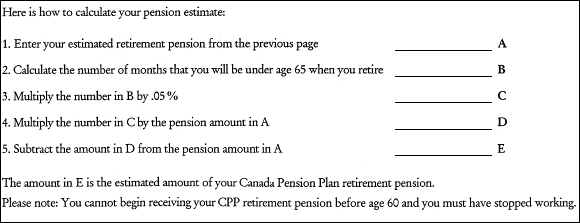 |
| Previous page | Table of contents | Next page |