|
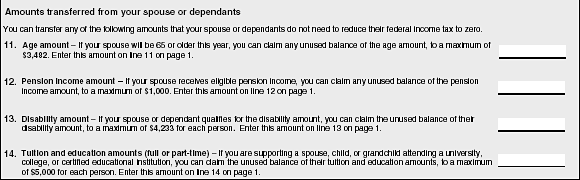
The final
group of tax credit amounts are transferred from dependants who don’t need
them because they have more tax credits than income. The cue to look at these
items involves a match on the words ‘transferred’ and
‘spouse’ or ‘dependent.’ The form-filler asks something
like: “Do I have a dependent/spouse? Those not having dependants or a
spouse would skip this section and go straight to the final line where they are
instructed to add lines 1 to 14. (It is unfortunate that this final line is
indented as it makes the line appear to be part of the group above. As it is
functionally similar to the steps in lines 1 to 10, it should be formatted in
the same way.) Those who have a dependent or spouse will have to check the
notes to see if any tax credits can be transferred.
The only new
information found in the notes on page 4 is the maximum amounts that can be
transferred in each category. We will assume that the transfer amounts have
already been calculated and are a ‘given’ as far as this form-filler
is concerned. To correctly enter the amounts, he or she will have to compare
each transferred amount to the maximum and enter the smaller of the two
amounts. For all four transfer categories, the type of information requested is
an amount (smaller) (2). The type of match is an integration (3); based on a
comparison (+0); matching one feature (+0); one response (+0); literal match
for given (+0); no inference needed for new information (+0); total rating 3.
Assume some distractors for the transfer amounts (given information).
(2) |
|
Type
Document |
Level
2 |
|
ToI
2 |
ToM
3 |
PoD
2 |
|