|
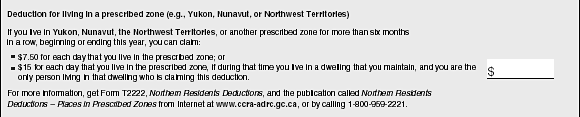
As with the
other claim categories on page 1, this one has to be scanned to see if the
criteria for a claim match personal circumstances. Presumably those living in a
‘prescribed zone’ would know it and would be looking for this
section. The rest of Canadians would have to infer what a prescribed zone was
using the three territories as examples–they would probably characterize a
prescribed zone as cold, remote, and north of sixty. (Actually a great swath of
Canada, including the northern half of most provinces and Labrador is
designated as ‘prescribed.’) Those in doubt are directed to the
extensive alphabetical list of place names in the publication Places in
Prescribed Zones.
The actual
task of calculating and entering an amount is a quantitative task. The amounts
used in the calculation have to be located in the text, based on a match of at
least four features (live in the prescribed zone, more than six months, in a
row, in a dwelling you maintain). The question asked at this point is “If
I intend to live alone in a one-room cabin in Nunavut for the first seven
months of the year, what is my deduction for living in a prescribed
zone?”
The
operation, multiplication, has to be inferred from the term ‘for each
day.’ The task is made more difficult because the ‘months’
needed to qualify for a claim, now have to be converted to ‘days’ for
the calculation. We will treat the number of days as the result of a previous
task rather than just being ‘given.’
Type of
operation: multiplication (3). Specificity of operation: numbers not in row and
column (1); numbers are not adjacent (+1); labels present, numbers identified
without a search (+0); operation is easily inferred (+1); numbers identified in
a previous task (+1); units require no transformation (+0); total rating 4. No
distractors. |
|
Type
Quant. |
Level
2 |
|
ToO
3 |
SoO
4 |
PoD
1 |
|