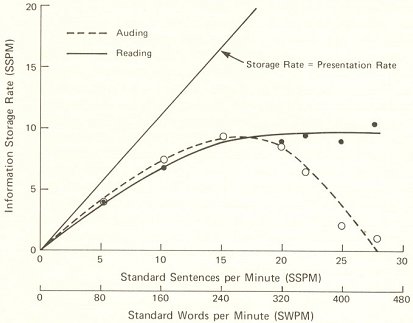
Figure 7
Information storage rate as a function of information presentation
rate for auding and reading.
NOTE: Adapted from Carver. 1973 @. with permission of the author,
To summarize briefly, research reviewed indicated that: (a) Typical oral reading rates for professional oral readers (newsmen; readers for "talking books" for the blind) are around 175 wpm, with a standard deviation of 25 wpm, hence auding rates of 175 wpm are typical for persons auding such presentations. (b) A national sample of 17-year-olds and young adults silently read at rates of 185-195 wpm, suggesting that, typically, such persons do not read silently much faster than they aud newscasts or radio programs. (c) When requested to read aloud as rapidly as possible without loss of intelligibility, trained oral readers can produce speech rates as high as 250-340 wpm. (d) When adults are presented spoken materials for rapid auding, comprehension typically holds up well for speech rates up to 250-300 wpm, then declines more rapidly. (e) A national sample of 17-year-olds and adults showed less than 10% of the population reading above 300 wpm, with the 75th percentile reading at 231-247 wpm; additional studies indicate that high school students and college students-that is, the better readers in the country typically read at rates of 250-300 wpm. (f) Studies which have directly compared the effectiveness of auding and reading, at different rates of presentation of the material up to 350 wpm, show comparable levels of comprehension for the two processes at the fastest rates.