Thus, as with auding, reading ability is influenced by at least two sets of factors: (a) the competencies needed for visually exploring and extracting information from visual displays, such as the use of peripherally encountered information to efficiently guide foveal scanning (Schiffman, 1972); and (b) languaging factors, including the scope of the sign system and the effectiveness with which this system is used for inter- and intra personal communication.
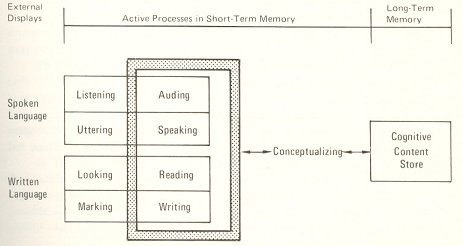
Figure 2 presents a schema of the various processes discussed earlier, as well as some to be discussed later on. Here we will mention only receptive languaging processes, but a similar account holds for the expressive processes. Auding is the joint occurrence of languaging and listening processes; reading is the joint occurrence of looking and languaging. The receptive languaging components serve to transform verbal or printed displays into non-language conceptualizations which constitute the meaning of the message to the receiver. The conceptualizing process continually merges input from the languaging process with information from the cognitive content store to build the subjectively experienced, meaningful message.
Figure 2
Processes in Languaging