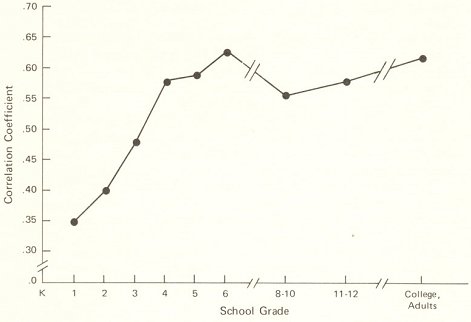
Figure 6
Correlation between auding and reading test performance for various
studies, as a function of school grade level.
These findings are consistent with the prediction of Hypothesis 2: Performance on measures of ability to comprehend language by auding is predictive of performance on measures of ability to comprehend language by reading, and this prediction is most accurate after the decoding skills of reading have been acquired. Furthermore, the data of Figure 6 suggest that such decoding skills are sufficiently developed by the fourth grade to permit auding and reading correlations of the maximal value obtainable by such "mixing pot" techniques as used in constructing Figure 6. Presumably, with well designed studies in which such factors as auding and reading rate, range of difficulty of content, response mode, and test format were controlled, and samples broadly representative of a given age group were used, correlations would rise above the .6 level of Figure 6. Goldstein's (1940) study comes closest to fulfilling these requirements with adults, and his correlation of .78 represents about a maximal coefficient, given the reliabilities of the reading (.86) and auding (.80) tests he used. The fact of the matter is, however, that no such studies have been performed with children at different school grades, so the data of Figure 6 cannot be taken as accurately quantifying relationships between auding and reading at various grade levels.