|
How women who study the job market see it In her 1989 Labor Market Paper on Women, Diane Alfred from EIC presents two models to show what is happening in the labour market now. 
In the donut model, the hole in the middle stands for the core jobs. These are full-time, full-year jobs, usually in large companies or governments. Employment is stable, wages are sufficient and there are opportunities for promotion. Core jobs make up less than half of the total employment in BC. The donut, or the fastest growing part of the model, is the peripheral jobs that are growing up around the core jobs. These jobs are in consulting, self-employment, contract work, part-time, and part-year work. They are the result of employers wanting to buy services for a specific time or a specific task. In the wedding cake model, Alfred presents three layers of the labour market. She points out that the cake is actually pyramid-shaped with the largest layer being at the bottom and the smallest layer being at the top. The bottom layer consists of entry level jobs usually at close to minimum wage with no career path (dead-end jobs). This is where the mismatch between employers and job seekers is most evident. There are more vacancies than can be filled and there are also many unemployed people who are not trained to do any other work. People don't take these jobs or keep them very long because they don't make enough money to live. Employers in this area are going to have to offer higher wages, training opportunities and fringe benefits to attract workers. Workers without specific marketable skills in high demand areas such as nursing or electronic engineering will have to consider these service jobs in the bottom layer as permanent careers.
These middle layer workers need to acquire a specific skill that employers are looking for such as technical or sales skills. Their other option is the self-employed, contract route. The top layer of the cake consists of technical specialists such as highly qualified engineers, health care professionals, those with international trade experience, and people who can sell almost anything. These are professions where there is an excess demand. Workers at this level can offer their skills on a world-wide labour market and often work outside the country. When employers cannot fill a job at this level they do not hire from the second layer. The mismatch between the employers' needs and the workers' skills is expected to grow because the majority of new jobs created will exceed the current education and training level of most workers. This is why people are now being encouraged to increase their education and training. |
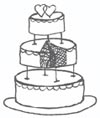 In the second layer of the cake
are workers who have education and/or experience, but they do not have a
specific marketable skill. An example of these would be the white collar,
middle managers (such as social workers) who were laid off due to cutbacks in
the private and public sectors in the 1980s. Rosalyn Kunin, an economist,
speaking at BCIT, has pointed out a shift in the wedding cake model. The top
layer at 30 percent of new jobs is now bigger than the middle layer at 20
percent.
In the second layer of the cake
are workers who have education and/or experience, but they do not have a
specific marketable skill. An example of these would be the white collar,
middle managers (such as social workers) who were laid off due to cutbacks in
the private and public sectors in the 1980s. Rosalyn Kunin, an economist,
speaking at BCIT, has pointed out a shift in the wedding cake model. The top
layer at 30 percent of new jobs is now bigger than the middle layer at 20
percent. | Back | Contents | Next |