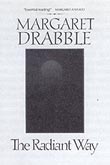
Margaret Atwood has compared The Radiant Way to Middlemarch in its scope and sympathy and, in many respects, the resemblance is powerful. On a second reading, the welter of information Drabble provides is more obviously unified and structured. Not only does Drabble interlace the stories of the three women, but she also roots them specifically in the political, moral and social setting. Drabble has praised George Eliot's ability to combine social situations with individual passion and here she attempts the same sort of vast integration. The construction of the novel parallels its subject matter. Instead of being divided into conventional chapters, the book consists of two huge central portions, the second of them taking place three and a half years after the first. These two "mega-chapters" are bracketed by the introduction which describes the New Year's Eve events and by a short epilogue. Drabble has described her usual narrator as "slightly bewildered;" the self-conscious voice of this narrative does not claim omniscience, but appears to have a considerable access to her characters. Sometimes she curtails her insights firmly, if a bit whimsically. In the midst of providing background information about Alix's husband, the narrator interrupts herself and her reader: But that is another part of this story, and not to be pursued here, for Brian is not a woman and reflections on his prospects or lack of prospects in 1952 would at this juncture muddy the narrative tendency. Forget I mentioned him. Let us return to Liz, Alix and Esther. The Radiant Way ends in June 1985 on Esther's fiftieth birthday. The chain of horrible murders has ended with a psychopath's arrest. Liz, her mother dead at last, has uncovered the mystery of her father's disappearance. In the process she discovers her own childhood copy of The Radiant Way, the school primer which Charles used for the title of his challenging TV series, now long abandoned for less controversial work. On the book jacket are "a boy and a girl running gaily down (not up) a hill, against a background of radiant thirties sunburst.' The same sunburst-behind-the-clouds illustration decorates the opening of each of the four movements of the novel. It also provides the tranquil, quite unsentimental atmosphere of the novel's conclusion. As Liz looks at the little book: the children aged, slowly. They skipped down hill for ever, along the radiant way, and behind them burned for ever that great dark dull sun. Liz shook her head, slowly, smiled to herself; slowly. It was beautiful, it was necessary. she said to herself. She touched her locket, she laid her fingers on the images in the book. She had been very near to knowledge. She would go no further, today she would nurse her strength, for the next encounter. THE GROUNDING OF Nancy F. Cott. New Haven: Yale University Press, 1987. Deborah Jurdjevic Nancy Cott, in The Grounding of Modern Feminism. argues for a plurality of feminist causes, recognizes that feminism allows "a range of possible relations between belief and action, a range of possible denotations of ideology or movement." Cott's book is an important one, not only for the sake of historical accuracy and for the sense of perspective that it brings to women's causes, but also for its sensitivity to the truth-telling properties of language. Her thesis is that the new language of feminism marked the end of the 'woman' movement (the nineteenth-century phenomena which resulted in women getting the vote), and marked specifically the emergence of a modern political idea of woman. Feminists of our century, recognizing individuality and heterogeneity among their members, affirm their collective identity by their opposition to sex-hierarchy, by their recognition that women's condition is socially constructed (neither God nor Nature is responsible), and by their shared sense of identity (gender grouping) which itself is the basis for social change. Cott' s study focuses on the years 1910 to 1930 and intends national scope for the struggle to discover "language, organization, and goals adequate to the paradoxical situation of modem women." With an historian's appreciation for detail, Cott refuses to generalize, believing that summary betrays the truth of things. But while the poet and the historian may be atone in this faith in synecdoche, the general reader is somewhat numbed by the variety of causes, movements, ideologies to which women paid allegiance in the early decades of this century. (The introduction thoughtfully carries an alphabetized list of no fewer than thirty-two acronyms.) While there is, in some cases, an overlap of interests among these distinct groups, there is more often an indication of conflict along class or racial lines. Cott's study recognizes and affirms 'difference.' When 'difference' threatens to overwhelm her study, Cott reverts to metaphor. Nineteenth-century feminists, for example, divided on the issues of individual rights and social responsibility, are credited with achieving a "stereographic or double-lensed view, bringing reality into three-dimensional focus." |
| Back | Contents | Next |