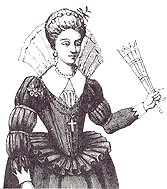
Mulcaster (c. 1532-1611) was perhaps the most influential of a group of school-masters/spelling reformers of the Elizabethan era, and he had an immeasurable effect on reading and spelling in England and America (Balmuth, p. 126). On the question of female education, Mulcaster's position was consonant with the climate of the late 16th century, although he went somewhat further than his contemporaries in advocating formal education for more than just upper-class women. In a chapter entitled "Education of Girls" in his book Positions (1581), Mulcaster makes this case for educating girls: "Our country doth allow it; our duty doth enforce it; their aptness calls for it; their Excellency commands it" (DeMolen, pp. 125-126). Yet, though he obviously felt that women were capable of acquiring learning, Mulcaster also cautioned that a woman's being learned could not override the practical effects of her being of a low social status; for example, there was little chance of her marrying upward (DeMolen, pp. 140-141). The fact that Mulcaster's monarch, Elizabeth was a learned woman, assuredly helped the cause of advanced education for women, as reflected in this statement by Mulcaster: That young maidens can learn, nature doth give them, and that they have learned our experience doth teach us;... what foreign example can more assure the world than our diamond at home;... if no example did confirm it that young maidens deserve the training. this is our own mirror, the majesty of her sex, doth prove it in her own person, and commends it to our reason. We have besides her highness, as under shining stars, many singular ladies and gentlewomen (DeMolen, p. 133). The Influence of Puritanism The newer teachers and members of the new education-supporting classes mentioned above often were Puritans, opposed to the Church of England. Many of them, too, were followers of John Knox, whose antagonism to women's education has been noted earlier. One effect of having so much of the grass roots schooling of the latter half of the 16th century in Puritan hands was the dissemination of Puritan values which, ultimately led to a new family structure. In the new structure, the wife was a help mate to her husband, with circumscribed duties. This prescriptive family, headed by an authoritarian husband/father, served a religious need: the Catholic practice of group worship centered in the church was replaced by the ideal of each family household becoming a center for worship, with daily services, Scripture reading, and other practices that depended upon a clearly defined family model with responsibility for education as well as religion. In the realization of the model, the aspirations of the initial humanists and Protestant reformers regarding women's education were changed and in the changing, became intellectually lower with the effects felt in the 17th century. In contrast not only to the stated liberalism of the previous century but to the practices of many of the years prior to the 17th century, more and more limitations were placed on all women. The Elizabethan ideal of a rich classical education for upperclass women was supplanted by one that addressed a broader population of women, but called for much less erudition. That is, a new ideal arose of women of all classes becoming literate enough to read the Bible for themselves and perhaps to teach it to the children and servants of the household - but not much more. For high-born women, the prevailing ideal was more secular, and included the graces required of a socially accomplished wife - the Cavalier values of the 17th century left their mark in this respect. In practice, the formal schooling actually available to females barely reflected even those limited ideals. For women who were too poor to hope to preside over a domestic domain, there was practically no provision. For the middle classes, though there is little data on the precise extent of primary school education for girls, the picture that emerges is one of very limited resources. On the secondary level, girls were rarely permitted into the grammar schools, nor were they sent as often as boys even when they might have been welcome. Thus, even the Quakers, who believed in female education, only provided two female and two coeducational boarding schools out of a total of fifteen that they had established by 1671 (Stock, p. 70). There were some female boarding schools for a limited number of the well-to-do, but their curricula, with rare exceptions, were aimed at developing socially acceptable rather than learned women. For women's higher education, the possibilities were even more closed off. Dissolving the convents had eliminated those institutions as sites for any kind of women's scholarly advancement; nor were women permitted into the secular centers of higher learning - the universities. How women reacted to such limitation of opportunity is a natural question. The answer for the 17th century is equivocal: on the one hand, women in general believed that a woman's social life, as well as her morality, could be endangered by too much learning. Yet, there are indications that such caution did not mean that women considered themselves innately inferior. In Elizabeth Jocelyn's treatise, The Mothers Legacie, to her unborn Childe (1624), she hints at an inner pride covered over with self-protective diffidence: I desire (if the child be a daughter) her bringing up may be learning the Bible, as my sisters do, good housewifery, writing and good works: other learning a woman needs not: though I admire it in those whom God hath blest with discretion... But where learning and wisdom meet in a virtuous disposed woman, she is the fittest closet for all goodness. She is like a well-balanced ship that may bear all her sail. She is - indeed, I should but shame myself, if I should go about to praise her more. (Watson, 1906 p. 118). |
| Back | Contents | Next |