|
Dorothy delivered a healthy baby girl on November 9, 1987. Recently, she wrote this article for our student magazine, The Writer's Voice: I have been learning how to be a good
mother. Dorothy had been coming to East End Literacy for several years before she got :ad pregnant with Natasha. She of had always been extremely quiet and inarticulate. She had not made much progress at reading and writing. She could copy letters. and read simple stories that she had dictated herself. When Dorothy got pregnant, she needed information and support. Because we were having a women's group at the time, she probably got more of these things from us than she would have before. After Natasha was born, Dorothy was away for awhile, learning how to care for her newborn. The women's group, which had only been funded for one year, had ended. But soon Dorothy returned to the reading center for her weekly session with her tutor, Marty. Dorothy was different. She was bustling, chatty and competent as she showed off her daughter and bundled her back into her snuggli. And she also seemed able to learn faster. One day, we were working on the manuscript for I Call It the Curse! and we dropped in on Marty and Dorothy's tutoring session to test it for readability. We did not expect Dorothy to be able to pick out more than a few words but she read the whole thing with very little help. “Dorothy! You can read so well” we said. Dorothy, preoccupied with getting home to Natasha, didn't seem particularly moved by this discovery. But after their tutoring session, Marty came into the office. "I'm so glad you noticed," she said. "I don't know how it happened. Before she had a baby she could read a little, but since she had her baby she really made terrific progress." Of course we are not recommending having babies as a way to become literate. But Dorothy is a dramatic example of the way that self-respect and self-confidence affect people's ability to learn. The were many times in the course of the women's group, when we wondered if what we were doing - sitting around talking- had anything to do with literacy. Rose and Debbie and Dorothy taught us that it did. For many women, literacy does not start with instruction. It starts with getting the things that prevent learning out in the open and out of the way: the ugly, debilitating memories, the lack of social and economic supports, and the years of being told, over and over until to you believe it, that you can't learn. Community-based literacy programs are under a lot of pressure right now, from some funders, to justify the way we teach, and to report on learners and their progress in ways that can be easily categorized and measured. This kind of reporting helps our funders to justify the money they spend, but it does not help learners to learn and tutors to teach. The Secretary of State Women's Program, which funded our women's group, allowed us the flexibility just to get the women together and see what happened. If we had been required to have a plan, we might never have found out what they wanted to learn, and what they needed before they could learn. We do not know how to measure the learning that took place in the women's group. We hope that we have shown in this article why, sometimes, it is important not to try to measure, but rather first to listen, and to understand, and then to tell what happened. Vivian Stollmeyer became a volunteer at East End Literacy in 1985 and has been a member of the staff collective for two years. Before that, she worked in the theatre. She is pregnant, and looking forward to a different kind of learning experience in 1989. Sally McBeth has been a member of the East End Literacy staff collective since 1983. Before that, she worked in community journalism. She is the mother of a three-year-old boy. 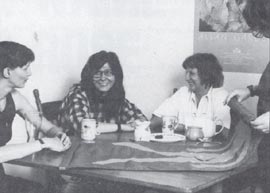 |
| Back | Contents | Next |