|
The tragedy of Ganga Devi was that when she became ill with the burden of supporting the life and health of others, she was treated by alien (allopathic) health systems which had reduced the able woman to a helpless dependent on expensive drugs. She never recovered and died after a long resistance. Ganga Devi was one of the 280 million illiterate women of India. A statistic we look upon with horror, dismay, shame. Yet Ganga Devi could read the earth, the plants, the woods, the trees, the sun, the sky, the clouds, the rains, the sowing, the harvesting, the seasons, the people, the births and the deaths. She could predict droughts by looking at the length and intensity of the orange-red coloration of the cob-like ovary of the Himalian Snake plant; the intensity of the summer by the redness of the flowers of the silk-cotton tree. INVERTED PYRAMIDS THEORY
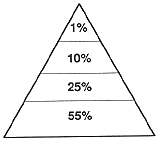
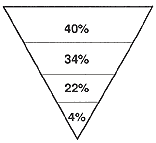
I who have a Ph.D. in Psychology can read none of these. Yet me and the like of me are squandering the meager- resources of the third and fourth world. We are valued, protected, reimbursed and set high in the peculiar value system of schools and ivory towers of learning in our morally decrepit and bankrupt, destructive civilization. For the last two thousand years, the privileged, the elites, the parasites have been riding on the backs of the millions who toil to keep and maintain us, the top dogs. And we in our arrogance have not even acknowledged this service, never asked what price we have extracted from the wretched of the earth. All over the earth, it is the illiterate poor, and it is the women who are the poorest of the poor and the most illiterate from the villages, that are the mainstay of a country's economy, through their cheap labour and their contribution in food production. In the northern states of India, by and large it is the women who are mostly involved in tending the land and the animals, whereas the men aspire to a more comfortable life in offices and cities. The Food and Agricultural Organization (FAO) has found that women in rural areas grow at least 50 per cent of the world's food.1 In India there are 343.3 million illiterate persons (approximately 49%). The southern state of Kerala has the highes literacy rate of 69% and the desert state of Rajasthan has a rate of 24% with the lowest female rate of literacy at 12%. In the Himalayan State of Himachal Pradesh, the literacy rate is 42.48% males, 58% and females, 31.4%. In the rural areas it is 46.42%: males, 51% females, 29%. In the urban areas, 67.44%: males, 73% and females 60.6%. In the Shimla rural areas, 37.16% 1iteracy: males, 49.54% and females, 23.74%. Ganga Devi lived and died in the village Ghana Hatti, 12 km west of the capital, Shimla. It is the rich and elite of the cities, the Neo-Brahmins, who are the beneficiaries of the country's educational system, a system which can be well represented by the inverted pyramids theory. The top 1% enjoys 40% of the National Income and resources, whereas the lowest 55% gets only 4%. There are a number of schemes to alleviate poverty, but hardly a trickle filters down to those who really need it. 52% of the population is below the poverty line; i.e., they hardly get two square meals a day. Malnutrition, anemia, V.D. and T.B. are rampant in the hills. Ivan Illich has been vindicated: the inroads of development have only bled the countryside. The so-called green and white revolutions (wheat, rice and milk) and the apple-revolution of the Himachal Pradesh have only gone to nourish the cities. These cash crops are not for the rural poor. Zafar Futehally finds, "Whatever development [there has been] has led to only menial jobs for the hill people with the bulk of profits going to outsiders from the plains."3 Cement-concrete houses and Japanese watches (male properties) have been traded for nourishment and health. Again it is the women and children who are the victims of our present day 'development'. Mental illness has been found in Himachal Pradesh to be higher in females of agricultural occupation, lower casts, lower education and income.4 |
| Back | Contents | Next |