|
Immigrant women's literacy: holistic learning, job
training, a safe place to learn
Recommendations
Consider
whether the broader context of women's issues can incorporate the uniqueness of
immigrant women's experiences, or whether it is necessary to create a separate
space.
Ensure the creation of a climate where all women are welcome and
the wide range of women's realities are reflected.
Lobby for the recognition of credentials gained elsewhere and
for less restrictive conditions for immigrant women's employment as domestic
workers, etc.
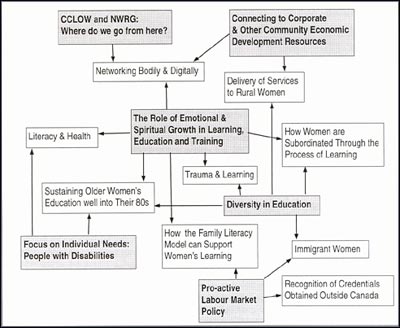
CCLOW/NWRG-where do we go from here?
Members, Board
members and interested parties of CCLOW and NWRG joined to discuss their
respective organization's history, mandate, climate and structure. It was
acknowledged that the infrastructure of the women's movement in Canada has been
seriously eroded; very few national women's groups are still active and very
few opportunities remain for women's groups to directly influence policy and
decision-making. With specific respect to education and training, the sphere of
influence has changed with the devolution of responsibility to the provinces;
what is the role for a national organization? There was significant discussion
of some important differences between the two organizations: that the mandate
of each is broad, yet the only overlap between the two is in the area of
training (where NWRG addresses training issues related directly to women's
labour market participation and CCLOW addresses training as part of women's
larger participation in all aspects of society); NWRG membership is based on
organizational representation whereas CCLOW's membership is open to individuals
and organizations alike.
Based on these and further discussions that the members of each
organization held separately, it was concluded that the mandate, organizational
structure, constituency and focus of each organization did not at present allow
for a smooth or effective merging.
How does the family literacy model support women's
learning?
Many misconceptions exist with respect to family
literacy, including that it is based on a "deficit" model of the family; that
it resembles a pre-school literacy program; that it does not address the needs
of women outside their role as mothers; that the term "family" applies only to
a limited configuration of people. Yet research shows increased motivation,
longer participation and more sustainable advances in literacy levels in both
adults and children among participants in family literacy programs. The role of
women in their families-where many women feel their greatest strength-cannot be
ignored in any truly effective educational approach.
Recommendations
Dispel myths and misconceptions about
family literacy by promoting information on its woman-positive philosophy,
collaborative and multidisciplinary approaches and the success of its
programs.
Build support in women's organizations for the role of family
literacy in the process of women's life-long learning.
|