|
2.5 Undergraduate University Enrollment
FIGURE 3 indicates the overall increase in women's enrollment in
university during the 1970-1984 timeframe. FIGURES 4 and 5 elaborate on the
general enrollment data by exploring the increase in particular subject areas.
These FIGURES show that:
- Women's overall university enrollment has increased
substantially from 1970/1971 and again during the years of the Decade for
Women, with the most dramatic increase occurring in part-time
enrollment.
It is possible that special efforts during the Decade may
have encouraged more young women to enter university. It is also likely that
the poor state of the economy during this timeframe contributed to the increase
in university enrollment, since out-of-work students may have returned to or
continued their education. However, the fact that women's enrollment rate grew
faster than men's is likewise noteworthy.
- Increases in the percentage of women in the traditionally
female disciplines (Education, Arts, Fine Arts) were modest but women continue
to be represented disproportionately in them.
- The large increases in women's enrollment occurred in the
less traditional disciplines, a trend that appears to have begun prior to the
Decade and continued through it:
- women's share of enrollment in
Medicine increased by 51%, from 27% in 1975/1976 to 41% in 1983/1984
-
women's share of enrollment in Law increased by 73%, from 26% in 1975/1976 to
45% in 1983/1984
- women's share of enrollment in Commerce increased by
109%, from 21% in 1975/1976 to 44% in 1983/1984
- women's share of
enrollment in Engineering increased by 120%, from 5% in 1975/1976 to 11% in
1983/1984, but remains well below their total share of undergraduate
enrollment in this field.
It may be speculated that increasing university enrollment is
closely related to and interactive with the increase in women's workforce
participation. That is, as women now expect to remain in the workforce for most
of their adult lives, they tend to seek a higher level of education. In turn,
as women obtain a better education, they are more likely to put it to use in
the workforce.
FIGURE 3
Changes in Undergraduate
Enrollment of Women and Men
1970/71 to 1983/84
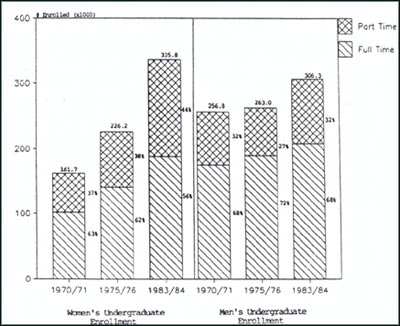
Source: Statistics Canada: Education in Canada
(Annual) Cat. #81 - 229
A clear commitment on the part of educational
institutions to create policy on part-time study which is of benefit to women
(i.e., which takes into account women's other responsibilities) would likely
result in further increases in the participation of women in the fields where
they are presently under represented. |