|
FIGURE 8
Change in Women's Share of
National Training Spaces
1977/78 - 1983/84
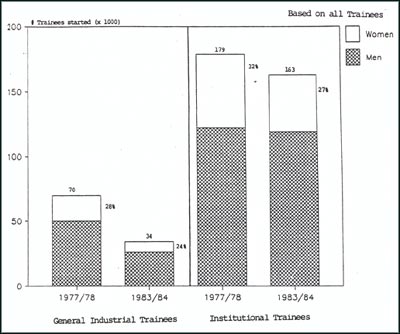
Source: Employment and Immigration Annual
Statistical Bulletin, 1977/78 and 1983/84
FIGURES 9 and 10 document women's share of the
various trainee categories funded under the National Training Act (Employment
and Immigration Canada).*
Together, the FIGURES illustrate:
- The decline in General Industrial Training (GIT) has been
more rapid for women who are employed than for those who are unemployed.
- Very little training is provided for either women or men who
are employed in threatened sectors of the workforce.
- About two thirds of Institutional Training falls into two
categories: Skills Training and Apprenticeships, categories of training which
lead most directly to jobs. Women's share of these categories (30% and 4%
respectively in 1983/84), is lower than their share of other training areas
(ranging from 42% to 81% share of other types of training in 1983/84).
The number of Skills Training spaces has declined and women's share of
these spaces has also been reduced. Moreover, women still have virtually no
share in Apprenticeship training.
- Funding for spaces in Basic Training Skill Development
(BTSD), a training area with high female enrollment in 1977/1978, had been
reduced by half as of 1983/1984. Since female enrollment had also declined,
women received a lesser share of fewer spaces.
- Two other training areas funded by Employment and Immigration
Canada, each with a very small number of trainees, underwent changes from
1977/1978 to 1983/1984:
- Job Readiness Training grew slightly but
women's share of spaces within this program declined; work Adjustment Training
(WAT) declined, as has women's share in it; enrollment in Language training has
increased, so that although women's share is slightly down, the absolute
numbers of women in this area has grown.
- Occupational Orientation
courses had an 81% female enrollment in 1983/1984.
* Employment and Immigration Canada Annual Statistical
Bulletins, 1977/78 and 1983/84. |