|
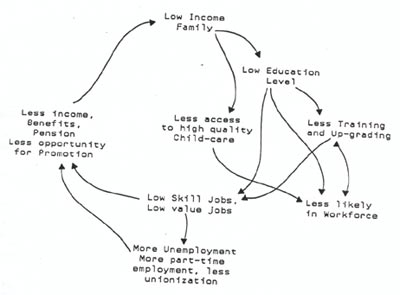
* Analysis derived from Lin Buckland. Education and Training: Equal Opportunities or Barriers to Employment In Abella, Hon. R. Commission on Equality. Supply and Services Canada, 1985. Facilitating increased participation of educationally disadvantaged women in the workforce requires a willingness on the part of the three levels of government to provide adequate financial support in the form of travel allowances, access to distance education, child-care subsidies and/or on-site child-care and financial assistance for their living expenses while they are in school. As evidenced by training financed under the National Training Act, the Government was (and continues to be) unwilling to make payments sufficient to cover actual costs. Nor did educational institutions accommodate these women's special needs. Educationally disadvantaged women may also need Adult Basic Education and "school readiness" training (similar to "job readiness" training) to increase their confidence and assertiveness. To date, Government assistance in these areas has been small and poorly advertised. Lack of adequate Government assistance in the areas of education. training and employment is especially evident when the plight of sole support female heads of households is examined. As was the case in 1975, half of these women continue to have family incomes among the lowest 20% of Canadian families. Since this sub-group of women, on average, is less well-educated than women generally, they share many disadvantages with women who have low educational attainment (described above). In addition, sole support women are the most negatively affected by the pay disparity between women and men because they must support their children on the inadequate wages associated with women's traditional work. As a result, this group of women serves as a kind of "bellweather" for the status of all women. The outcome of women's unequal access to education, training and employment is that the current level of poverty among sole support mothers will continue and grow in the next generation. Women, who now must support themselves and their families on their inadequate wages, will also be required to live on the inadequate pensions which are the outcome of these wage and benefits structures. A second group that can expect to live in poverty in the coming decades is older women. As Canada's elderly population becomes larger and women continue to live longer than men. the size of this group is increasing. These women are most likely to have earned less than men over their lifetime (i.e., they worked for women's wages, many would have worked part-time and received no benefits or they did not work for wages). The plight of these sole support women (young mother and older women) requires urgent government intervention. |
| Back | Contents | Next |