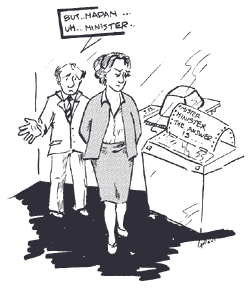
 Without wishing to give away any of the content of the Minister's Task Force Report, it strongly recommends that new committees be formed to tackle the question of what hardware to use, the question of programs to put into the machines, and a committee to see that enough teachers get computer training to allow this new technology to be properly used. As important as the above issues may be to education decision-makers, I'm sure the common sense and intelligence of teachers will bring forth even more important concerns. The point is, computers and all systems developed through micro technology must always - always - be considered a tool, and not an end to themselves. There is an ever-present danger that the complexity of computer systems can put a great deal of control beyond the reach of people, and that the computer itself will assume growing power. Some of the new machines, with the promise of artificial intelligence, may usurp established patterns. An apocryphal story illustrates the point: two scientists had built the world's biggest and best computer. Even using micro-chip storage capacity and bubble memory, this machine still took up eight storeys of office space, but it had every piece of knowledge known to man. Every human language, every bit of folklore, every bit of scientific information and philosophy was stored within its memory banks. Finally, the day for posing the most important question in the world arrived, and the scientists slowly posed the question: "Is there a God?" The computer took nary a second to answer. In its deep, mechanical voice, it boomed forth, "There is now." Frankly, that is often the way in which computer aficionados see computers. It is a frightening prospect. As an educator myself, I can tell you that it is also a prospect educators will not accept. Of course there will always be a place for the teacher to wipe a runny nose or hug a frightened child, to admonish a class that has been careless of the rules or someone's feelings. That is the human element, which no computer could ever duplicate. But beyond this personal, human touch lies the greater need for broad education, to teach children to live and work effectively in the computer age. They must learn, as I said before, to use computers as tools - and very effective tools they are. But human learning, human understanding, and the need to learn to live fully within our global village on human terms must always take precedence over technical knowledge and technical application of the machines that we have created for our own benefit. The symbol the Chinese use for the word "crisis" means both danger and opportunity. That is exactly what computers pose to the school system: danger and opportunity. Opportunity to provide new and exciting job opportunities for women, once stereotypes are attacked and discarded; danger, if such technology allows us to forget that education requires a moral and humane content. There is opportunity as well, in decreasing some of the routine of learning. I have seen children completely engaged in meeting the individualized challenges which computer-assisted learning can present. There is danger if the time spent in front of a machine is taken from the time children spend with one another, learning to socialize. Writer Tom Wolfe suggested that the 1970s were a decade of narcissism, a decade of the "me" generation. If computers are programmed to meet individuals' needs at the expense of each of us learning to understand and help one another, then western society will not advance beyond the "me" generation. I don't believe, however, that Wolfe's "me" generation is anything but a minor wrinkle on mankind's collective face. Indeed, there is reason to believe the opposite - that mankind will use computers to extend the abilities of the handicapped, to explore new areas of science from the cosmos to the microcosms. The ancient Greeks defined happiness as "the full use of one's talents along the lines of excellence." As far as computer technology extends men and women's talents in the pursuit of excellence, it should be neither feared, nor discouraged. The very fact that women are gathered here at this conference to consider the consequences of this new technology is proof that it is being met as a challenge, not as a danger. |
| Back | Contents | Next |