|
B. Sexually Transmitted Diseases and HIV
Part of sexual health is preventing diseases. Ask learners what
they know about sexually transmitted diseases. Clarify that HIV is one sexually
transmitted disease of many, and that many sexually transmitted diseases can be
cured.
 Someone in your
group might have HIV, or might love someone who does; present HIV as an illness
which can be treated although not cured. Someone in your
group might have HIV, or might love someone who does; present HIV as an illness
which can be treated although not cured.
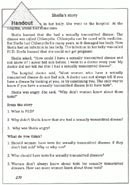
1. Reading: "Sheila's Story"
|
* * * * * * * * * * * * * * * *
Learners may be
interested in doing some wider reading about STDs, for example, Taking Care:
A Handbook about Women's Health, page 150
|
|
* Read "Sheila's Story" with your
learners.
* Ask learners to discuss and write the answers to the questions
at the bottom of the page.
* Other questions to consider:
- Does everyone with a sexually transmitted disease tell their
partner?
- What are some reasons to tell your partner?
- What are some reasons not to tell your partner?
2. Make a list of what people
know about HIV
|
* * * * * * * * * * * * * * * *
In the second
column, learners may say, "I heard it somewhere." This answer is a good one
because it does not request disclosure.
* * * * * * * * * * * * * * * *
Learners who
have HIV may not know that some doctors specialize in treating patients with
HIV, and that medicine for HIV can extend their healthy years and help their
babies not get HIV, and that they must tell a doctor that they have HIV to get
the treatment that is best for them.
* * * * * * * * * * * * * * * *
This free
pamphlet is inclusive, and addresses women's concerns. Although it is hard to
read, you can present the information section by section, use the stories, or
help learners read and adapt it.
|
|
* Make a list in three columns. In the first column, write
everything the group knows about HIV. In the second column, write down where
they learned each fact. In the third column, list things the group wants to
know.
3. Reading: HIV information
This chapter does not supply facts about HIV. I suggest that you
use these or other readings and invite a sexual health educator to your group.
At the time of going to press, these readings were available and up-to-date.
However, you may find more current information to use with your class. Your
learners may be interested in reading several different pamphlets, starting
with the easier ones.
* Read and discuss the AIDS issue of The West Coast Reader or
English Express.
* Read and discuss page 1 and half of page 2 of the pamphlet
"Women and AIDS: Choices for Women in the Age of AIDS."
They are easy to read, newspaper-type factual presentations. You
only need to read one of them; they are almost the same publication. If you do
not have back issues, the AIDS supplement can be ordered. See "AIDS Education
Newspaper" from TESOL in list of pamphlets in Resources (page
159).
4. Guided discussion
Understanding how HIV is transmitted through body fluids can
help learners understand safer sex instructions and evaluate risks for
themselves.
* Stress that infected body fluids must first get out of one
person's body and then get into another person's body for her to get HIV.
* Look at the diagram of body fluids in the English
Express.
* How can people get other people's body fluids into their
bodies? Some questions to consider:
- Which body fluids are passed when people share needles? have
intercourse? are born to a mother who has HIV? get a blood transfusion? get a
tattoo when needles are not cleaned well? share a straw or rolled-up bill to
snort drugs?
- Why do nurses wear latex gloves when giving personal care?
Do gloves protect them and you?
- Which body fluids should you keep away from open cuts? (All
of them, including blood, semen, vaginal fluids, mucus, urine and feces.)
- If you get only a little infected blood or body fluid into
your body, can you get HIV?
- Why don't people get HIV by shaking hands? hugging? using a
toilet?
5. Writing
|
* * * * * * * * * * * * * * * *
"Caring Safely
for People with HIV or AIDS" explains precautions with body fluids.
|
|
* Ask learners to answer these questions:
- Write three ways people can get HIV.
- Write two or three ways people can protect themselves from
HIV.
- How do most women get HIV?
|