|
C. Song: "Lies"
Moon Joyce is a 42-year-old white lesbian of mixed English and Ukrainian ethnicity. With a fascination for life-long learning, Moon uses many creative tools in her teaching and facilitation to inform, challenge and consolidate key insights of the moment into usable, enjoyable forms. She says, "'Lies" is a song that only hints at the deep anger I feel every time I see the profit margin of the pornography industry and the effects of that industry on the bodies of those whose lives touch mine daily."
1. Warm-up * Ask learners to pick a picture of a female model from a
favourite magazine. 2. Understanding the song * Ask learners to listen to the song to find out what type of magazine she is singing about. Listen to the song as many times as needed. * Read the words to the song (page 175) to
check if people are on the right track. 3. Guided discussion/debate * Look again at the lines "I am an adult, I have my right to buy anything I want to." Are an individual's rights more important than the effect pornographic magazines have on society?
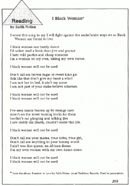
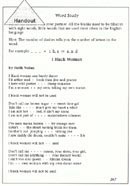
D. Song: "I, Black Woman"
Faith Nolan was born in Halifax, and her parents and extended family were coal miners in Cape Breton, Nova Scotia. Her commitment to social justice comes from her life experiences and those that she grew with through the cultural tool of music. Her politic is firmly rooted in her being working class, woman and African Canadian. "I, Black Woman" is from her album Freedom to Love. 1. Warm-up
* Ask learners to work with a partner to discuss this song. A
tutor and a learner could be partners.
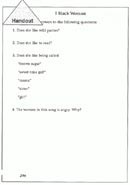
2. Understanding the song * Ask learners to continue to work with their partners:
3. Word study * Ask learners to do the cloze exercise on the song (page 179). 4. Guided discussion
* Look at the last verse of this song: Don't call me your mama, your sister, your girl * Some questions to consider:
5. Writing * Ask each learner to make a list of names that s/he finds
hurtful. Resources (See the Bibliography for complete listings and for ordering information.) "Singer of the Sacred Heart" written and performed by Connie Kaldor, Out of the Blue 1994. "A Cautionary Tale or Aren't You Glad That You Know Wen-do?" written and performed by Jane Field on The Fishing is Free 1994. "Lies" written and performed by Moon Joyce. on The Infinite Edge 1985. "I, Black Woman" written and performed by Faith Nolan on Freedom to Love 1989. |
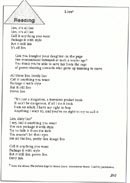
 "Lies" is on Moon's
album The Infinite Edge. This song may touch off strong feelings in
those who have been involved in the pornography industry, in those who use
pornography and in those who are forced to watch it.
"Lies" is on Moon's
album The Infinite Edge. This song may touch off strong feelings in
those who have been involved in the pornography industry, in those who use
pornography and in those who are forced to watch it. 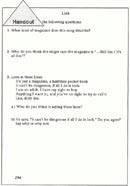
| Back | Contents | Next |