|
A. Introduction 1. Writing * Ask students to write about their feelings about poetry, in a short paragraph, a few sentences or a few words. Ask students to put their names on the papers. Save them to be returned at the end of the poetry unit. 2. Brainstorm
* Brainstorm the word "poetry" for 10 - 15 minutes with your class, recording on a flip chart. This could also be done by individual students, with the results posted on the wall afterwards. * Then brainstorm and discuss "Canadian poetry." B. Theme: Motherhood In this section there are poems from the point of view of mothers, children and grandchildren.
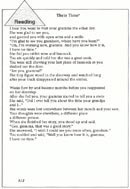
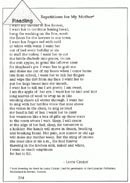
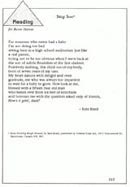
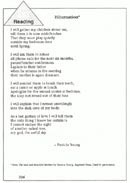
1. Reading: Several poems * Spend 15 - 30 minutes introducing, reading and discussing each of the following poems and their authors:
* Introduce only one or two poems per session. Before reading any poem, you might give a brief biographical sketch of each author, show photographs if possible and pass around any of their books, or anthologies and periodicals in which their poems have been published.
* Introduce any new or difficult vocabulary. 2. Guided discussion and review * After the group has read all the poems, over several sessions, discuss the similarities and relationships between them. Some questions to consider:
3. Follow-up activities * Make a collage: Look through magazines for pictures that could be used to illustrate the poems; this could be done individually, in pairs or in larger groups; make collages to be posted around the room; the titles of the poems, authors' names or lines from the poems could be sprinkled throughout the collage. * Write: Choose the poem that you like best or that has the most meaning for you, and write a paragraph outlining your feelings
* Research: Ask students to look through the books for other poems that would fall under this theme and share them with the group. Write a poem: For reluctant writers, try formula poems, which are fun and gratifying. Here is one example: line 1: first nameline 2: four adjectives describing yourself in a positive way line 3: mother (father, son, daughter) of _____________ line 4: lover of (list 3 things) line 5: who feels (list 3 things) line 6: who fears (list 3 things) line 7: who would like to ________________________ line 8: last name
Mary |
| Back | Contents | Next |