|
* * * * * * * * * * * * * * *
Using a specific
image to begin the unit helps to encourage learners to talk about their
experience (in this case, thinking about being at school, working and learning
with others). As beginning level learners first speak and use vocabulary that
they know, the next steps - reading and writing this language - are put into a
context. Learners already have a sense of what they will be reading and
writing, because the oral work has enabled them to use the words they know, and
maybe, also, to learn new words from classmates. |
|
A. A
Typical Day
The word "typical" might be unfamiliar to some learners. Other
words or phrases, such as "every day," or a "regular" day might help learners
to think about what it is they do from day to day, in order to begin
discussions. Starting with day-to-day activities (a relatively impersonal
topic) allows learners to talk as much or little as they like about things they
do and people and things that are important to them. As learners get to know
each other, they can decide how deeply they want to discuss issues in their own
lives related to the topic.
1. Guided discussion
* Begin by showing the learners a photograph, such as the one
shown here. Ask learners what they see in the photo. With very beginning level
learners, the process of writing observations (on the blackboard or flip chart)
might take an entire class session.
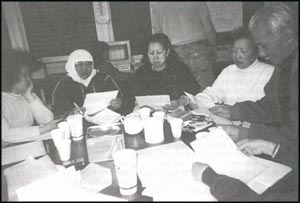 A group of learners in the
Rainmaker Project, in Vancouver. Parents of children at Macdonald Elementary
School participate in language and literacy work at the school, in a classroom
shared by children using computers. A group of learners in the
Rainmaker Project, in Vancouver. Parents of children at Macdonald Elementary
School participate in language and literacy work at the school, in a classroom
shared by children using computers.
* Learners can first describe what they see, and then talk about
the range of issues that arise when we think about women's concerns and
educational opportunities abroad and in Canada. Some questions to consider:
- Tell me about the picture. What do you see?
- Who is in the picture?
- What are they doing? Where are they?
- What do you know about the people in the picture?
- What questions do you have about the people in the
picture?
Sample responses:
|
* * * * * * * * * * * * * * * * Tutors might begin
with photos of their own friends or family, or with photos taken from
magazines. As learners come to know one another, they should be encouraged to
begin to share their own photos; learners' photos provide the best starts for
discussions. As learners talk about the photos, and make guesses about what is
in them, tutors can assess how much vocabulary learners have already acquired,
and can help fill in gaps. |
|
I see ________________________________.
They are _____________________________.
They ________________________________.
* Move from questions about a specific image, or a reading
related to that image, to questions about what people do at home, about the
people in their households, or about very general activities.
- What do you do every day?
- What do you do in the morning?
- What do you do on Saturday?
- What do you do on Sunday?
|