|
C. Listening to the Old
Messages
1. Reading: "Listening to the
Voices"
* Introduce the idea that during childhood we learn many
messages that we continue to tell ourselves. If those messages are negative,
they can get in the way of learning. ..
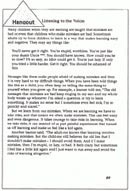
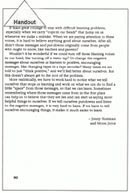
* Read "Listening to the Voices" (pages 68).
* Get the group to talk about whether they hear old discouraging
messages when they try to learn. Do they hear or tell themselves that they are
stupid, or lazy, or...?
2. Writing
* Ask student to write the discouraging messages they hear in
their heads, then think about a way they could say something more encouraging
to themselves. Write that down too. Working in pairs might help them think of
something good to say to themselves if they are stuck.
|
* * * * * * * * * * * * * * * *
For example,
when students can only hear the negative, it might help them if they remember
what someone else who always encourages them would say to them, or they could
think what they would say to someone else if they were having the same trouble,
or they might take a break and do something else until they feel ready to give
it another try. Encourage students to think of something they can try to turn
things around next time they feel they cannot learn.
|
|
* Talk about what it felt like to do this exercise and whether
they can believe the good things they wrote down. They might want to pin up the
encouraging
D. Looking at Learning
1. Exploring the highs and lows
*
* Introduce this exercise, which has been adapted from a book
about creativity. Its purpose is to help you look at the situations which cause
your mood to go up or down, and explore how you feel about yourself in these
situations.
* However you choose to organize it you will need to call out
instructions step by step. They are:
|
* * * * * * * * * * * * * * *
You could do this
exercise as a whole group first, writing down all the words students call out
on the board or flip chart paper Then encourage students to write what applies
to them from the words already written on the board. Alternatively you could
start by putting lots of possible words on the board and explaining their
meaning. Then students could do the exercise alone, taking any words they want
to from the board.
|
|
- Divide the paper or board into two halves.
- On one side write all the words which come to mind when you
remember being in low spirits. For example, "flat," "bad-tempered,"
"grumpy," "low," or "grey." Call out, or write, any words that come to mind.
- On the other side write all the words which come to mind
when you remember being in a good mood. For example, when you are
feeling great do you feel "high," "flying," "sailing," or "glowing"? call out,
or write, any words that come to mind for you.
- On the low side write some things you actually do, think
and feel when you are in a low mood. For example, do you yell at the dog,
eat junk food, think I'm so stupid," feel like quitting. . . ? Call out, or
write, any words that come to mind.
- On the high side write some things you actually do, think
and feel when you are in a high mood. For example, do you feel full
of energy, feel like celebrating, laugh a lot, buy gifts. . . ?
- On the low side think about the situations, experiences,
people and events that seem to be part of your low mood. What are the times you
feel particularly bad, what makes this situation or this person or this
experience get to you? For example, you have to deal with a welfare worker and
her tone of voice makes you feel in the wrong and. . .
- On the high side think about the situations, experiences,
people and events that seem to be part of your high mood. What are the
times you feel particularly good? What makes this situation help you feel good?
For example, you realize you can learn something you thought you would never
understand, or a friend supports you. . . .
|
* * * * * * * * * * * * * * *
If this exercise
was done as a whole group, you may want to follow up with students doing it for
themselves or you may just want one collective version.
|
|
2. Guided
discussion
* What did you learn about yourself as you thought about how to
answer each question? Some questions to consider:
- Were you surprised by any words which came to mind?
- Did you notice any patterns or types of situations which
make you feel good or bad?
* Ask students to think of a title for the positive side of
themselves and for the low side.
3. Writing
* Ask students to write about an experience of learning when
they felt all the positive things. They could use their titles for the positive
side. They should give as much detail as they can and use as many of the words
on the board as they want. They should share their writing if they choose.
* Encourage students to keep that piece of writing and re-read
it, or remember everything about feeling positive, so that they can reconnect
with those good feelings when they are feeling lousy, and remind themselves how
good they can feel. |