|
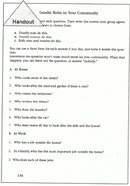
B. Gender Roles in Your Community This section tries to define fairly closely what the gender roles are in the communities students belong to. There are many parts to this activity, and they could be spread over several sessions, according to the literacy skills of the students and time constraints. 1. Questionnaire
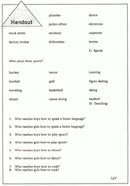
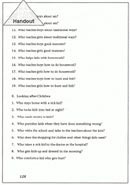
* If you have a group, divide them into smaller groups so that people who share cultural values are working together to answer the questions. The size of each small group doesn't matter. Some people may work alone. Sexes should be mixed. * Give each group or pair or individual a copy of the questionnaire "Gender Roles in Your Community". Each group should come to an agreement on the answers, and fill in a single questionnaire. If group members can't reach an agreement on a particular question, ask them to leave it out.
When I did this with my class I put some thought into deciding how to divide them into groups, according to the communities, racial and class, that I thought they belonged to. The groups I set up were: a group of First Nations people; two white women born in Canada, who later described themselves as working class; two white men born in Canada, who later described themselves as middle class; one white woman who had grown up in Italy and who came to Canada as a young woman, some 20 years ago. I asked them to go into these groups by naming the individuals, not by naming the groups; when it came time to make the chart (Section B-2) I asked them to name their community themselves. As they started to work on the questionnaire, I went around to each group to check that there was a fair amount of agreement on the answers. I found that inside most groups, people pretty much agreed, but when one group overheard another group talking, there was often disagreement between groups. I took this to mean that I had been fairly successful in dividing them up. However, the group of First Nations students was having a lot of disagreement. I had asked all the First Nations people to form one group, as I knew they all had families living in the area. When there was so much disagreement on the answers, they soon figured out that those who had grown up in Duncan had different ideas from those who had grown up in the United States, even though some of their families were related, and their common heritage was Salish. They were happy to separate into two groups and after that they had no difficulty coming to an agreement inside each group. 2. Make a chart * Ask each group to make a chart like the one shown on the following page, which will summarize the discussion they had while answering the questions. * Ask them to fill in the name of community at the top. 3. Display the charts * Ask each group to present its chart to the large group. Allow lots of time for questions and discussion and comparison. The class may want to display the charts on the wall. * Review or introduce the definition of a gender role, and apply the term to the charts as they are presented to the large group.
|
| Back | Contents | Next |