|
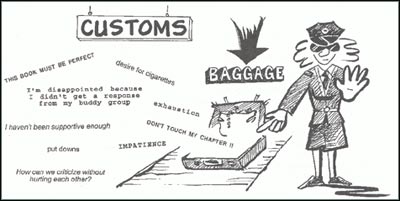
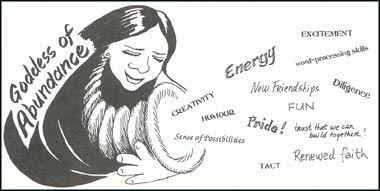
We meet again We began by unpacking, metaphorically, the negative "baggage" we had brought with us, but in spite of that, the sight of all the chapters together was inspiring; we were amazed by the diversity of the work we had produced. Next, we spent some time affirming the strengths, skills and sense of positive purpose we brought to the meeting.
Nevertheless, we went into the meeting with some fear; we were seeing the whole collection of chapters for the first time, and everyone was worried. Some of us had particular criticisms of other women's work that we didn't know how to broach; many of us were comparing our chapters to other people's work and finding our own wanting in some respect; everyone was aware of how different the various chapters were - could they really make a coherent whole? Elaine helped us begin to voice these criticisms by suggesting we find someone we felt safe with to say all the negative things we had to say. Her reasoning was, "If I can say what I need to, I might be able to hear what others are saying. If I am critical, I can understand others being critical. If I notice how much others are self-critical, I may realize I don't have to voice all my criticisms." For some of us, that initial venting, to a safe ear, freed us up to do the work we had to do. Others still felt the tension when they discussed their chapters with women whose politics were very different. We went over the chapters in great detail. We worked alone, in pairs, in groups, and in whirlwinds. The feedback which we had been largely unable to give over distance during the past year flowed from us. Assumptions that had been made at the last meeting were cleared up. Small and large changes were made to the chapters; some were completely re-written, others tightened up. Each of us drew on her own experience to make suggestions about other chapters, and learned from the others' experience. One of us, for example, who teaches in a literacy classroom would find out what might happen to her material in an EAL class; a tutor might suggest how she would adapt classroom material for a one-on-one situation. The guiding questions in every discussion were: Is it clear and practical? Is it usable with learners? Is it inclusive? How is it feminist? As well as working on individual chapters we thought again about the whole book; one result of our discussions is the material you are reading in this introductory section. Finally we agreed on an editor, an editorial team, a time line for completion of revisions and field testing, and a format for the entire book. Each woman was to make revisions to her chapter, get some feedback from field testing, and send it into the editor. We made individual agreements with other women to continue the feedback process by mail and phone after the meeting was over. As we left St. Anne de Bellevue, many of us felt excited not only about the book but about the whole process. Some women, who more strongly identify as feminists, came away saying, "Yes, feminism is not a barrier; it is an enabler. Feminist principles have been at work here, and look what we have pulled off." Others, less strongly identifying as feminists, discovered or clarified certain ways of looking at the women we work with and our own roles as instructors and tutors, without being forced to "toe the party line." We hadn't backed away from disagreements, but respectfully pushed and challenged each other. We focused on our own experience, and re-affirmed that we (instructors, tutors, feminists, whatever the "we" is) cannot tell other women what their lives are like, but rather must clear the way to hearing what they want to tell us. Although diverse in our interests, backgrounds, values and beliefs, we came together with a purpose and respected each other accordingly. We were a group of women who spoke out and were listened to; our voices joined together to make a connection. |
| Back | Contents | Next |