|
A. Names
The objectives of this section are to examine the importance of
names and gender differences, and to get to know each other better. A book of
names with their meanings will be useful.
1. Learning about our names
* Ask each learner to translate his or her name into English, or
to explain the meaning in English, and to write this information on a piece of
paper, without signing it.
|
* * * * * * * * * * * * * * * *
You could use
one or both of these activities, which focus on first or given names. Some
learners might be able to explain the origin or the meanings of their last
names as well.
|
|
* Collect and redistribute the slips to the groups. Ask each
learner to read the information which appears on the slip s/he has just been
given, and invite the group to take turns guessing whose name it is.
2. Learning more about our
names
* Ask learners to take a large piece of paper, and, writing
large so others can read it from a distance, write her or his name in English
in the centre.
|
* * * * * * * * * * * * * * * *
The
information in this reading comes from an excellent discussion which emerged
from the previous topic, when we talked about names given to women and men. I
certainly learn a lot from my group of four engineers, two Chinese and two
Koreans. The fact that the two Koreans recognized Chinese characters
facilitated the communication among the group.
* * * * * * * * * * * * * * * * *
In many parts
of Canada, First Nations people were given names by colonizing missionaries. At
first, they were simply given first names which were almost like labels. They
were common informal British names such as Jim, Bob, Johnny, Bill, George,
Peter. (To the colonizers, males were important, so male names were given as
family names. Women usually were given Christian names after conversion.) When
a child was born to "Bob" or "Jim," he was often given the name of another
relative, for example, "Jimmy Bob." Today, there are many families whose last
name is Jim, George, Jimmy, or Joe. The first name of people in these families
may also be George or Peter or Joe. This information comes from Evelyn Battell,
who spoke with members of the Cowichan Tribes, especially Louise Underwood.
|
|
* Ask learners to write the answer to any of the following
questions at the four corners:
- Who chose your name?
- Why was this name chosen? Does this name commemorate a
family member?
- What expectations do your parents and your family associate
with this name?
- What qualities or words would you associate with this name?
- What do you like or dislike about your name?
* Learners walk around the room holding the slip of paper in
front of them and reading what the others have written down on their papers.
* Each learner introduces another learner by recalling what was
written on his or her slip of paper.
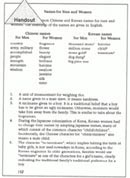
3. Reading: "Names for Men and
Women"
* With your group, read
"Names for Men and
Women."
* Based on the Korean and Chinese names, consider the following
questions:
- What do you think are the roles played by women and men?
- What name would you give to your child?
- Do you think that gender differences exist in English names?
- What do you think about these names: Chastity, Patience,
Hope, Faith, Gloria, Jasmine, Daisy, Rose, Mary, Christian?
- If you could choose a new name, what would it be?
* * * * * * * * * * * * *
This would be a good time to
introduce or review the use of the second conditional: "If + past tense, I
would, should, might, could. . ." |