|
Women's Group Action Read Guelph, Ontario Action Read is the only community-based literacy program in Guelph, a city of 86,000 people that is 100 kilometers west of Toronto. Action Read began in 1987 as a division of the Centre for Employable Workers. It became an independent program in 1991, electing its first volunteer community board in February 1992. At the same time, it adopted the Movement for Canadian Literacy's mission statement put forward by the Learners' Action Group of MCL. This means Action Read has fifty percent learner representation on all committees. The board is trained in and uses consensus decision making and conflict resolution techniques. 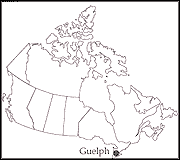
Action Read is located in a store front just off one of the main downtown streets. Its mandate is to provide literacy services for adults who need them. Their pamphlet states, "We believe that the learner knows best what their needs are. The learner sets goals and chooses materials which are personally relevant to them. This provides the basis for the work they do." Action Read receives funding from the Ontario Ministry of Education, the National Literacy Secretariat, Ontario Women's Directorate, and the United Way. There are five full- and part-time staff who work as a collective at Action Read. All are women and they have all become members of the national Feminist Literacy Workers' Network. One woman coordinates approximately fifty-five learner/volunteer tutor one-to-one pairs and small groups. One woman does the administration. Another woman works with the Family Literacy program. One woman assists with all these and with special projects that arise. One woman, Anne Moore, coordinates a women's writing project that has produced a book. Action Read has formed a company - Garlic Press - to publish the works of adult new readers. Many of the students at Action Read are long-time residents of Guelph who stay with the program for two or three years. Some of the students work for wages, some have recently become unemployed, some have been unemployed for a long period of time, and some receive disability pensions or social assistance.
A few students focus on English as a Second Language, although school board continuing education programs are the primary source of those classes in Guelph. About fifty percent of the students are women. Closer to seventy-five percent of the tutors are women. The age of the participants seems to be predominantly 35 to 45 years. |
| Back | Contents | Next |