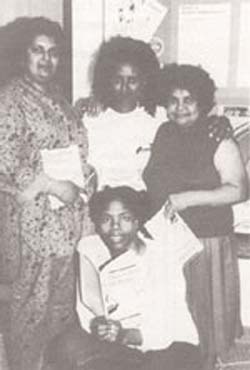
When Frances Ennis
visited the Toronto ALFA Centre in Toronto she met with some members of the
women's group. Front, Moisley. Back from left, Christeen, Amele,
Davie. |
At each program, Frances and I would spend from four to eight
hours talking With the two contact women about their community, their program,
and their woman- positive activity. We often talked about the first workshop
and lingering confusions, frustrations, or concerns. We also had a list of
questions to review at each site. We asked about what had happened around the
research so far, how students and staff had responded to the woman-positive
activity, and how the contact women were able to document those responses. We
explored what they were uncovering about their own responses.
We wondered how women fit the woman- positive activity and half
day of research in with the rest of their lives. We wanted to know how their
involvement had affected their personal, professional, and political lives. We
often took part in the activity while we were there, getting to know students
and administrators, observing the activity in its particular context. Finally,
we worked on drafting a description of each community, program, and activity so
we would have a "public" version of what was happening in this research.
2-4 The first
interview
During this first visit, Frances and I taped
an interview with each contact woman. We asked how she remembered finding out
about the project and what she thought we wanted to do. We asked how she
understood the idea of "woman-positive" at the beginning of the project and if
that understanding had shifted. We discussed what had happened so far that she
would describe as positive and what had happened that she would describe as
less positive. Following up on some of the discussion at the first workshop, we
asked how women would describe the relationship between woman-positive and
feminist, and whether their involvement, or their program's involvement, would
have been different if CCLOW had used the term "feminist" rather than
"woman-positive."
We usually taped the interview at the end of a two-day visit. We
used the interviews to discuss any leftover questions from the first workshop
and to lead women into reflection on the response of others in their programs.
Each woman received a copy of the transcript from her interview. She was
invited to change anything she felt was confusing, to add thoughts that she had
had since the visit, or to ask that information be masked or deleted. After
these responses were integrated into the transcripts, they became part of our
data. |