|
Power - Where do we see it, where is it hidden? Tannis Atkinson (Toronto ALFA Centre) started out curious about the differences between community college programs and community-based programs. She tried to understand the different outcomes of their activities by looking at the different ways power was expressed. Beginning with her experience at Toronto ALFA Centre, where staff and students developed a sexual harassment policy, she tried to identify what was invisible in that program's documentation. Through that process, she thought she might be better able to think about what lay behind the pages of other programs' documentation. Of course, this is something we can't know - especially from the outside. What is missing for one woman will not be the elusive piece for another. In any event, Tannis said in her presentation, the ethics of this research doesn't allow us to make visible what others have decided should not be shown here. Tannis ended by building a web chart illustrating how power and authority seemed to be expressed institutionally and through staff/ staff and student/ staff relationships. She included the ways that men staff and students have certain kinds of power over women students and staff. She looked at race and class privilege that crosses other boundaries. 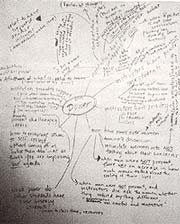
Emotions Kate Nonesuch (Malaspina College) decided to read through the documentation looking for different statements of emotion. She found over eighty-five different places where women used words that directly stated women's feelings. She listed the words and noted where they appeared and what they referred to. Happiness or elation topped the list. Other positive expressions of feeling included pride, excitement, love, fondness and friendship, and admiration. The second most common emotion was fear. Close behind were anger and frustration. Women also expressed sadness, self-blame, exhaustion, discomfort, disappointment, shock, and surprise. Women were happy to be participating in woman-positive activities. Bonding as a group, welcoming new members, feeling part of a national network, team-teaching, creating woman-positive materials - all these experiences made women feel good about themselves, their work, their students, and co-workers. Sharing the wisdom of women's lives, working through conflicts about what might or might not be woman-positive, writing reflective journals, and engaging in intense discussion also contributed to these feelings. Several different women mentioned the way in which women worked cooperatively in their activities as a source of elation for them. |
| Back | Contents | Next |