|
The Menstrual Cycle This is the time it takes a woman's reproductive system to get ready for the possibility of the growth of a baby in her womb. It is the time between periods, usually 20 - 36 days. The cycle begins when the menstrual blood starts to flow. The last day is the day before the next menstrual flow starts. If, for example, you begin to menstruate on the second day of the month and again on the 31st day of the same month, you had a 29 day cycle. Menstruation Menstruation is the blood that comes from the womb and flows out through the vagina about once a month. It is made up of substances that come from the lining of the womb if the egg has not been fertilized, and can last from two to eight days. The amount of blood lost is very little, about four tablespoons. Although some women feel uncomfortable during their periods, menstruation is not a disease and routine discomfort should not be treated as though it were the sign of a disease. The first time a woman menstruates is called the menarche. Dysmenorrhea Dysmenorrhea means uncomfortable or painful periods. For some women it can be very severe. These women should check with a doctor to find out the cause. Sometimes proper nutrition and exercise are all that's needed. Potassium and calcium are great for relieving cramps. Bananas are a good source of potassium. Milk and milk products are good sources of calcium. (See Nutrition, page 30.)
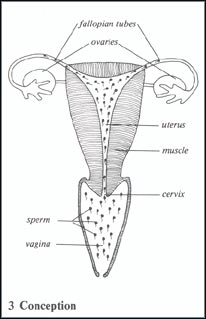
This means not having a period. It is usually a sign of pregnancy, but there may be other causes. After a woman stops taking the pill, for example, she may not have periods for a while. A woman should always check with her doctor to determine the cause. Conception Conception is when the sperm meets the egg and fertilizes it. (See illustration 3.) Sperm can live in the womb for up to five days so conception can take place if sexual intercourse occurs within 2 - 5 days before the woman ovulates. The egg must be in the outer third of the fallopian tube for it to be fertilized. The fertilized egg then travels to the womb where it implants itself in the lining (endometrium). |
 Amenorrhea
 | Back | Contents | Next |