|
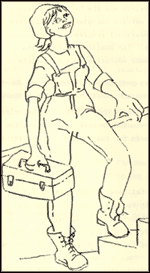
WOMEN INTO TRADES AND TECHNOLOGY The curriculum for the W.I.T.T. Program was put together in November 1981 by Susan Booth, Carol Brooks, Ken Murch and Barbara Brown of the Women's Workshop, London, Ontario under the auspices of the Ministry of Colleges and Universities in Ontario. In the spring of 1982 five colleges: Fanshawe, Mohawk, Niagara, Canadore and Sheridan, ran the pilot programs. These were favorably received by the students and the success rate was high. Across the province, of 22 colleges, approximately 15 will deliver this program during the 1983-1984 fiscal year. GOALS: The objectives of the W.I.T.T. Program are three: - to prepare women to enter skilled trades or - to qualify women for apprentice-ship or - to secure employment for participants in
Who qualifies. for a W.I.T.T. Program? The women must meet college and or/ CElC eligibility criteria and have a demonstrated interest in pursuing a non-traditional, industrial career. Any women who wishes to enrol as a fee-payer may do so. A woman on U.I.C. Benefits will continue to receive them while taking this program. Also, CEIC training allowances are available to those women who meet the criteria. The W.I.T.T. Program runs for 18 weeks and includes: one week orientation, 7 weeks of training in generic tool skills, 6 weeks of family occupational skills and 4 weeks of work placement training. Sixty percent of the time is spent on skill trades and technology and students learn welding, machine shop work, electronics, drafting, carpentry auto body and mechanics, electronics, appliance and computer repair. The balance of the time is spent in life skills courses plus a technical math refresher course, blur print reading, St. John's Ambulance, and a self defense course for women. Among the Life Skills topics covered are: assertiveness training, sexual harassment, decision making, goal setting, lab or market information, stress and time management. Testing includes career interest, aptitude, academic and mechanical reasoning testing. Students examine career choices in a number of ways. Speakers and women from industry, who can be seen as role models, make presentations, (CEIC and MCU Apprenticeship Branch). A variety of industry and college tours are arranged. These enable the students to experience these trades in the "World of Work". For 4 weeks, the students experience "hands-on" placement in the college shops and industrial settings. |
 The
goal of this course is to respond to future needs in the Canadian economy by
training women, an untapped source, in trades and technology.
The
goal of this course is to respond to future needs in the Canadian economy by
training women, an untapped source, in trades and technology. 
| Back | Contents | Next |