|
The Study estimates that approximately 190,000 Canadians are employed in the protected - vulnerable industries. It makes the important observation that the wages in these industries are considerably less than those offered by other Canadian manufacturers, and that although relatively few women are employed in manufacturing as a whole, women hold 63% of these lower paying, vulnerable jobs. Further, a large proportion of these jobs are held by immigrant women and women of color. The Study draws strong parallels between wages, jobs security, health and safety conditions, and their effects on women's social responsibilities and relationships in both industries, and in all parts of the world. The jobs are not good jobs, either in Canada or abroad. On the other hand women employed in these industries need to work and have very few options for assuring their economic survival. Women in Canada who are not fluent in English or French have very few employment possibilities. In newly industrializing countries women's options are limited because there are fewer jobs, and those which are skilled are accessible mostly to men.
In the electronics industry located in many Asian Export Processing Zones (more commonly referred to as Free Trade Zones), women find that they are hired on low-paid training contracts for several years, for work which takes them perhaps a month to learn. Young women employed in electronics, have a working life of approximately four years: after that period their eyes are usually too damaged to continue the work. Many women have become seriously ill through exposure to toxic and carcinogenic substances used in manufacturing microchips. Shift work both disrupts any routine in their lives, and requires that workers live near or in the Zones, sometimes in barracks provided by the company, isolated from their families and community. There are rarely unionized, precisely because many governments are prepared to back with force their promises to industry of an unorganized, inexpensive workforce. The book does not provide such useful glimpses into the identities or concerns of women's employers in the two industries. The apparently distasteful task of examining owners and profit is avoided through the authors' assumption that owner's interest are the same as those of their nation's. Jobs are discussed as benefits to nations' (while being of questionable value to the women employed), and nations are said to be in competition with each other for these jobs. International corporate competition for markets and profits is almost obscured, as is the relationship between corporate interests and national governments. This is unfortunate, because it is partly by looking at the structure of the owner- ship of the two industries that We can understand the differences between them, and develop appropriate strategies, and policy. Another recent Canadian book, Women on the Global Assembly Line by the Participatory Research Group provides a much clearer picture of the corporate interlinking and the international nature of the production process in the electronics industry. |
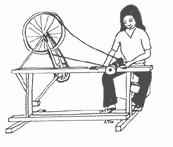 The descriptions
of working conditions are striking. The descriptions are the result of research
conducted by a diverse set of labor, development, and women's organizations;
creating an overview which is rather stark. In the clothing industry here and
in other countries, women work in factories, hired on production quotas, and at
home doing piece work. In most work situations, whether at home or in a
factory, there is rarely enough light or ventilation and many women experience
eye, respiratory, and stress related illnesses directly related to their
working conditions.
The descriptions
of working conditions are striking. The descriptions are the result of research
conducted by a diverse set of labor, development, and women's organizations;
creating an overview which is rather stark. In the clothing industry here and
in other countries, women work in factories, hired on production quotas, and at
home doing piece work. In most work situations, whether at home or in a
factory, there is rarely enough light or ventilation and many women experience
eye, respiratory, and stress related illnesses directly related to their
working conditions.| Back | Contents | Next |