|
In the evenings, the plaza outside became a stage for Latin American songs, dances, drums, comedy and theatre. These events were publicized and opened to the community. Popular entertainers were enthusiastically welcomed by everyone. The performers were obviously well known and appreciated. As a Canadian, it was a wonderful opportunity to experience some South American culture. The Latin rhythm is very contagious. The second day (Tuesday), the morning plenary session began with reports from each of the working groups and concluded "that access to education is a human right." Following these reports, a panel discussion on "The Contribution of Popular Education for Development and Peace" took place. The three contributors were Adolfo Perez Esquivel from Argentina (winner of the Nobel Peace Prize), Alexandre Vladislavlev (U.S.S.R.) and Lucille Mair (United Nations). Development was discussed as a means of achieving dignity, self-determination and liberation. Lucille Hair pointed out that women have found that their struggle for equality is inextricably tied to the struggle for development and peace. Interest groups met in the afternoon and regional meetings took place in the evening. 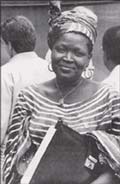
Following the regional meetings there was a reception for women participants in another room of the hotel. Dame Nita Barrow, who was also the convenor of the NGO Forum'85 in Nairobi, spoke about that conference. It was the world's largest ever gathering of women. Between twelve and fifteen thousand women from around the world came to Nairobi to meet, share and learn from each other. There were over 1,000 workshops, a "Tech and Tools Fair," a ten-day film festival, visits to nearby rural projects and markets where Kenyan women sold crafts. The "Peace Tent" became a central meeting place where women from countries with opposing political views came to debate and discuss issues. With Dame Nita Barrow as President of ICAE , the Assembly in Buenos Aires carried on the enthusiasm for getting women's issues to the fore-front. It was partly because of her encouragement and support that CCLOW has joined the International Council. Wednesday morning's plenary had a creative reporting session from the working groups. Using the format of the BBC News, each working group was heard from as though reporting news events. Commercials were given to cover housekeeping announcements. A panel discussion on "the Adult Education Movement in Action" took place. Contributors were Fun Dong Tang (China), Fernando Cardenal (Nicaragua), Peter Engberg (Sweden) and Nicholas Kuhanga (Tanzania). They emphasized the fact that there is no real development through adult education without a strong political will and popular participation. 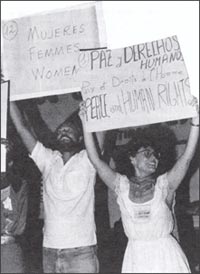
On Thursday, working groups met together all day, except for the opening reporting plenary sessions. I was sorry to personally miss most of these as I was involved in getting a new passport to replace the one in my stolen handbag. However, with the sessions I did attend, plus the many discussions with different women from the group, the following main concerns were raised throughout the week: literacy, worker education, income-generating projects and the role of women in the struggles ongoing in Latin America. That final evening, following empanadas and wine at the centre, and a Brazilian drum exhibition, the Assembly participants and Buenos Aires residents took part in a walk around the four blocks which surrounded the centre. With the drums leading the way we clapped to the Latin, beat and swung our way through the streets arm-in-arm with people we had met throughout the week. |
| Back | Contents | Next |