|
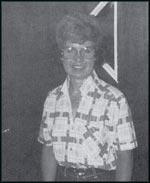
CHERYL MCINTYRE: FREDERICTON'S FIRST FEMALE SECURITY OFFICER Cheryl trained as a security officer at one of Fredericton's biggest shopping malls. She is the mall's first female security officer. She was one of the stars of the program. She excelled in the courses at the community college and is highly regarded by her training-place host. She was chosen to be valedictorian at the graduation. Cheryl applied for the program after four years on social assistance. She had come to Fredericton from Cape Breton and an unhappy 14-year marriage. She brought her three-year old daughter with her but had to leave her two sons behind. One of our concerns when Cheryl applied for the program was that, even if she found a job, she might be earning little more than she received on social assistance. It was almost certain to be less than she would make on the re-entry program, since it provided a dependent and childcare allowance. Both predictions proved to be true but neither dampened her enthusiasm. She is confident that her earnings will soon surpass her earnings on the program. But more important, she is off social assistance and has a life outside her home. She says that she plans to continue working until she reaches retirement age! Cheryl believes that she could not have got the job without the program. The mall management would never have considered a woman, especially one lacking specific experience and training. She also felt stigmatized by being divorced and on social assistance. Cheryl also says that she wouldn't have had the confidence to apply and go through an interview for any job other than cleaning. She found the life-skills training crucial for confidence building. Coincidentally, she says that life skills helped her with her children. She learned how to say no and mean it. Now when she says no, her oldest son says, "your school, eh?" Besides life skills, Cheryl found inspiration from the women working in non-traditional occupations who were brought in to speak to the group. They were all successful in their occupations - a stationary engineer, a policewoman, a union organizer - and were earning excellent salaries. Not only did they provide role models, but they had come from backgrounds similar to those of the participants. They had faced crises and overcome them. Cheryl remarried a few months after the program ended. She and her new husband have a combined family of six. Cheryl says that her husband had been suggesting marriage for a few years but she wasn't ready, feeling that she should do something for herself first. The re-entry program, proved to be that something.
JEAN LEGER: A CLOSED DOOR OPENS From the day she walked into the kitchen cabinet assembly factory where she did her training and now has a full-time job, Jean Leger knew almost all the workers. She had lived in the small community outside Fredericton all her life. She had been applying for a job in the factory since she was widowed seven years before. But the door was closed to her; each time she tried her application was filed. Now she is one of the best workers in the factory. The owner has only the highest praise for her. Interviewed on CBC radio as a graduate of the program, she charmed everyone with her enthusiasm and determination. Jean was widowed after eighteen years of marriage to her childhood sweetheart. Her children are 14 and 22. She left home at 16 to find work in Toronto; her family couldn't afford to keep more than one child in school. She returned to her community with her husband for the birth of their first son. After her husband died, Jean tried to find work, but could find only short-term make-work projects: five weeks in a fish hatchery, another five cleaning in a mental hospital. She remarried three and a half years ago and her new husband moved into her home. The marriage didn't work out - it was a "boo-boo" in Jean's words. They divorced after two and a half years and she was forced to apply for welfare. That lasted only two months. The same day she applied for welfare, she heard about our program and was eager to apply. She believes that the reason she couldn't get a job in the factory before was because of traditional community values. Women are expected to stay at home. This was made worse by the tense situation she and two other trainees encountered when they arrived at the factory. They had been taken on before all the regular workers had been called back after the winter lay-off. The workers staged a slowdown, which lasted for about two weeks until the situation was restored. Jean found the life skills and career orientation courses valuable. They built her confidence. She had a habit of belittling herself and couldn't accept praise. The assertiveness training helped her to handle various incidents at the factory including sexual harassment and being made fun of by a supervisor. Learning to write resumes and to handle interviews was essential - skills she had to miss out on when she left school early. Most of the information on labor and human rights legislation and unions was new to her; since working in the factory she has become aware of how little other workers know about their rights. The time and money management classes were not as useful because she already knew a lot about it. Most important was the support group
that developed Joan McFarland is the New Brunswick director of CCLOW |
 among the women. Sharing life
experiences was a new experience and meant a lot to her. She found that all the
women had been through similar life crises. Jean got a raise after five weeks
at the factory. And there is a new man in her life - a widower she has known
since childhood.
among the women. Sharing life
experiences was a new experience and meant a lot to her. She found that all the
women had been through similar life crises. Jean got a raise after five weeks
at the factory. And there is a new man in her life - a widower she has known
since childhood. | Back | Contents | Next |