|
There are striking parallels between the impact of SAPs on women in the South and the impact of cutbacks to social programs and workfare on poor women in the North. In fact, the cutbacks are being referred to as the SAPs of the North.
Education: Nairobi to Beijing
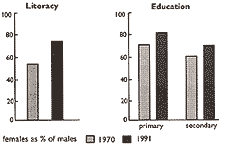
Education is considered to be an area where there has been much success in the last two decades. An editorial in the first day's Forum newspaper put education in the following context: "...a frustrating global pattern in women's lives shows them making rapid steps forward in education and health, while lagging seriously behind men in economic and political power" (italics mine).6 Positive gains have been made in closing the gender gap in the areas of basic literacy and primary and secondary schooling, as demonstrated by data released by the World Bank for the period 1970 to 1991 (see charts). However, as the Platform for Action itself points out: "more than five years after the World Conference for All (Jomtien, Thailand, 1990) adopted the World Declaration on Education for All and the Framework for Action to Meet Basic Learning Needs, approximately 100 million children, including at least 60 million girls, are without access to primary schooling, and more than two thirds of the world's 960 million illiterate adults are women. The high rate of illiteracy prevailing in most developing countries, in particular in sub-Sahara Africa and some Arab States, remains a severe impediment to the advancement of women and to development."7 In addition, the Platform cites discrimination in girls' access to education (paragraph 71), the absence of an educational and social environment where women and men, girls and boys are treated equally (paragraph 72) and persisting gender bias in curricula and teaching materials (paragraph 74) as some of the other factors that remain serious obstacles to equality in education. As goals, the Platform urges governments to eliminate the gender gap in functional illiteracy as promised in the Jomtien declaration (paragraph 81) and, by the year 2000, to ensure universal access to basic education and completion of primary education by at least 80 per cent of primary school age children (paragraph 80b); by the year 2005, to close the gender gap in primary and secondary school education (paragraph 80b); and before the year 2015, to provide universal primary education in all countries (paragraph 80b). In the Platform for Action, education is declared "a human right and an essential tool for achieving the [three goals of the conference], equality, development and peace" (paragraph 69). The section on education is greatly expanded compared to the Nairobi Forward Looking Strategies document (eleven paragraphs in the earlier. document compared to twenty in the " Platform) and many more areas are covered, for example, lifelong learning (paragraph 73) and the influence of media on education (paragraph 77). In addition, follow-up actions for governments, international bodies and communities are outlined and a list of resources required for implementation of recommendations and the setting of specific goals is included. |
 Lesbians had a strong and visible presence
at Beijing. At Nairobi, they had a very low profile and rumours had been
circulating that lesbians would not even be permitted to attend. At the Beijing
Forum there was a lesbian tent, numerous workshops on lesbian issues and
lesbians represented on workshop and plenary panels on a broad range of issues.
At the official conference, the lesbian caucus worked to get a "no
discrimination of the basis of sexual orientation" clause into the Platform
for Action but it was dropped (at the eleventh hour) in a trade-off over a
footnote that would have subordinated women's rights to national and religious
customs.
Lesbians had a strong and visible presence
at Beijing. At Nairobi, they had a very low profile and rumours had been
circulating that lesbians would not even be permitted to attend. At the Beijing
Forum there was a lesbian tent, numerous workshops on lesbian issues and
lesbians represented on workshop and plenary panels on a broad range of issues.
At the official conference, the lesbian caucus worked to get a "no
discrimination of the basis of sexual orientation" clause into the Platform
for Action but it was dropped (at the eleventh hour) in a trade-off over a
footnote that would have subordinated women's rights to national and religious
customs.| Back | Contents | Next |