|
So there I was for the next ten years, taking a part-time course load as I regained the use of my senses. One or one-and-a-half courses a year was all could handle because of my decreased reading speed and lower energy levels, which combined to reduce any immediate comprehension of the material.
My final years at that university were constrained financially. Although by this time I felt I could successfully attempt more than one- and-a-half courses a year, a student assistantship would only pay for that number. There was no other way to earn or "win" more money either by scholarship or student loan, since neither are awarded to part-timers. (Okay, there is a student loan for part-timers, but it requires repayment in full after 30 days so it only works for those temporarily strapped for cash.) This Catch-22 traps many mature students and single mothers, and others who must work to finance their education and others who must work to finance their education. Low-paying student-type jobs mean working more hours, which reduces available study time, which in turn lowers marks, eliminating eligibility for scholarships. All of the above problems were in addition to the "normal" student trials and tribulations of too many midterms and papers due in too short a time span, of ill-prepared professors, etc., etc., etc. Normal student extra-curricular and socializing activities (ie. hanging out with others) suffered as well since I did not have' the time or energy to participate. This led to a sense of aloneness, and occasional paranoia. Graduation a couple of years ago brought a sense of relief that I was finished. . Finally. But a job search was too daunting. I couldn't face competing with the number of younger, healthier graduates also seeking employment in the then depressed job market. And there is the fact that the provincial Disability Assistance I receive is contingent on not working, at all, not even part-time. After the first $100 earned per month, the gross amount earned is deducted from the disability cheque at a 75% rate. I worked two days a week for six months at minimum wage and ended up owing the government more than $640 over and above what had already been deducted from my monthly assistance cheque. Working at Jess than minimum wage, in effect, is not an incentive to finding gainful employment. Since I am still not capable of a 40-hour work week, carrying on in school is my only alternative to sitting at home doing nothing. And I have tried that. It's a waste to watch the: apartment walls all day, but volunteerism also leads to a cut-off of assistance. I started studying for an MBA degree at different university two years ago. The rules and regulations of the new place are different and in some ways easier. During my previous degree, I had the sense that any alternative arrangements I proposed would be seen as cheating. For example, I described to an acquaintance how writing an economics exam had so exhausted me that I "forgot" how to walk: I had to consciously think about shifting my weight to the left, swinging my right leg forward, shifting my weight to the right, swinging my left leg forward. He suggested that instead of writing a three-hour exam in one stretch I should ask for two one-and-a-half hour stints with time off for rest in between. But after some thought, I decided it was not my place to propose such an arrangement. Indeed, I concluded that if such an idea was possible it would have been broached already by someone in authority as an alternative. My current university has that very policy in place as an alternative for disabled students. The Atlantic Centre of Support for Disabled Students, on campus, arranges for extended time, large print, computer aids, etc. for exam writing by disabled students, as well as other services like note takers in class. I still have to study and learn the material, which refutes any previous conditioning that this "easier" way is cheating. 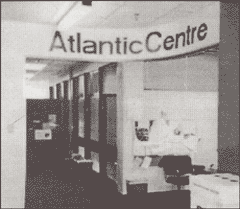
The Atlantic Centre of Support for Disabled Students at St. Mary's University |
| Back | Contents | Next |