|
APPENDIX B - MATERIALS FOR INITIAL
READING, ASSESSING THE STAGE ONE READER
INTRODUCING THE PICTURE SHEETS: The tutor/teacher should say the following to the learner:
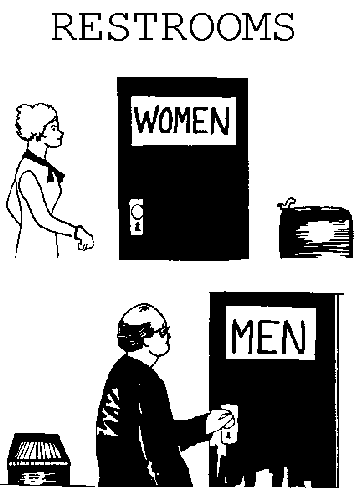
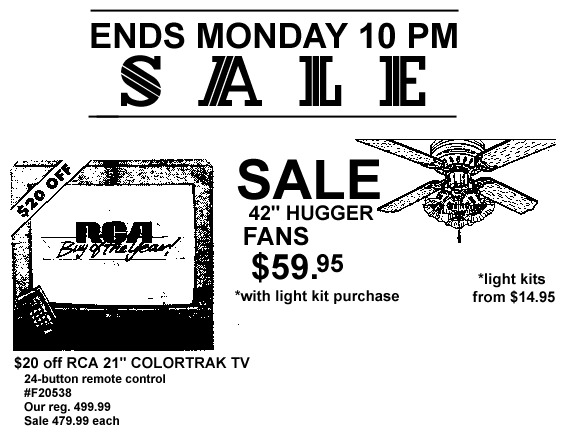
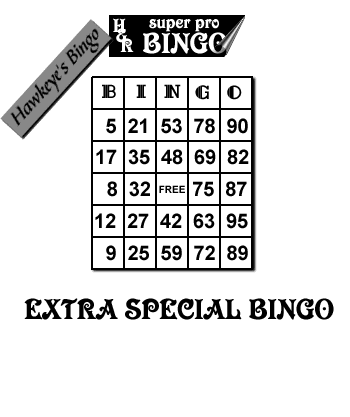
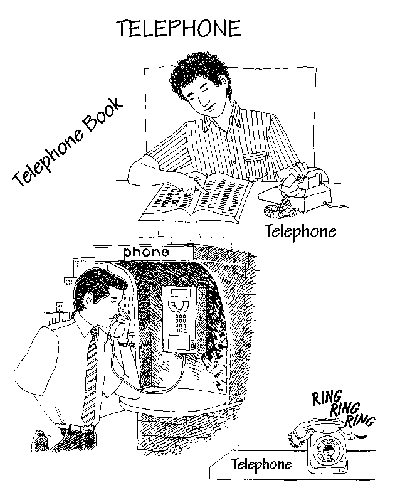
OBSERVING THE LEARNER READING: You might use the picture pages in the following ways: To determine how well the learner can predict words in context. Show the learner each card and ask him/her to guess at what the words on the pages say. Encourage ]earners to use the pictures in order to make logical guesses. If the learner makes a guess which does not seem to make sense to the tutor, then the tutor should ask the learner, " what made you guess that?" The learner may have a good reason for guessing as he/she did. To determine how well the learner can discriminate similar letters and words. On some pages words are repeated. Ask the learner to match words on each page. Or you can say "How many times does the word "bingo" appear on this page?" To determine what letters of the alphabet the learner recognizes and can identify. Select one of the pages. Ask the learner to name the letters he/she sees on the page. Writing and Spelling Learners at this stage may be able to do simple writing tasks such as their names or addresses. They may be able to copy writing and often know the alphabet from memory. ADDITIONAL SUGGESTIONS FOR ASSESSING A STAGE ONE LEARNER These ideas are taken from the work of Mary Norton. A. Knowledge of uses and purposes of literacy and concepts about print/text:
B. Knowledge of language patterns, print and letter sound associations:
ASSESSING STAGE TWO AND THREE READERS The ideas and suggested reading materials on the following ten pages are taken from the Initial Assessment Pack developed by the Literacy and Continuing Education Branch. Additional ideas for assessing Stage Two and Three readers are included after these pages. In assessing stage two and three readers it is recommended that the learner be allowed to chose reading material that he/she will feel comfortable reading. Tutors should not feel obligated to use only the reading selections included in this Appendix, but they should feel free to offer the student newspaper and magazine articles, literacy reading books and any other materials that they consider appropriate. Learners should be encouraged to read aloud and to guess at the words they do not know. It should be noted that, in general, most learners can read better than the artificial conditions of an interview session would indicate. THINGS TO OBSERVE WHEN THE LEARNER READS:
ASSESSING THE STAGE TWO LEARNER If you suspect your learner is at Stage Two, you should use the cards indicated with a B in the upper right-hand corner. READING Introducing the Reading Cards The tutor/teacher should say to the learner:
Show the four cards to the learner. Read the title at the top of each for the learner. As the learner to choose one. Then say:
Observing the Learner Reading Do not interrupt the learner while he/she is reading. However, if the learner is stuck, help him or her out. If the learner reads these passages with ease, you may want to ask them to read something from Stage Three. If the learner makes less than five errors, then the passage is well within the learner's reading level. If learners make more than 5 - 7 errors, this material will be within their instructional level. However, they will not be able to read material this complex on their own. After the learner has read the passage, ask him/her to retell it to you in his/her own words. You can then see how well the learner is reading for comprehension. WRITING AND SPELLING You can ask the learner to write a few simple sentences or a short paragraph. Encourage the learner to guess at how words might be spelled but don't be surprised if the learner takes few risks in this situation. This writing sample should give you an idea about the following:
ASSESSING THE STAGE THREE LEARNER If you suspect your learner is a Stage Three learner, you should use the cards indicated with a C in the upper right-hand corner. READING Introducing the Reading Cards The tutor/teacher should say to the learner:
Let the learner choose one of the C cards. Observing the Learner Reading Do not interrupt or correct learners while they are reading. Give encouragement if you feel the learner is asking for it. When the learner is finished reading, ask him/her to tell you what it was about. Fluent readers should be able to recall most details. Even if a number of words have been misread, the learner should be able to summarize the passage. WRITING AND SPELLING The learner should easily be able to write a paragraph or two about some personal experience, job experience, hobby, interest in education, etc. The learner at this stage should have general ideas about paragraph construction and sentence construction. The learner should be able to use a variety of sentence forms even if punctuation or grammar is not yet accurate. You should discuss spelling with the learner and encourage him/her to guess at how words are spelled. |
PICTURE SHEETS FOR STAGE ONE READERS
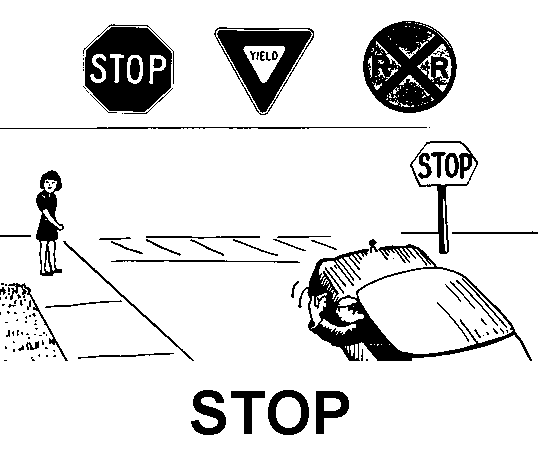
READING CARDS
Last night the temperature was -34 degrees. When Tim tried to start his car this morning, there was nothing but a sick sounding "rr...rrr...r...rr". Tim forgot to plug in the block heater and now the battery was dead. Tim has to drive his car to work because there are no buses. Tim need a boost for the battery. Luckily his neighbour, Mary, was just leaving her house for work.
| ||||||||||||||
It was raining hard. Water covered the road. The truck moved slowly. Its heavy tires cut a path in the water. Madge was driving. She never took her eyes off the road. Len watched the road, too. Two pairs of eyes were better than one. it would be easy to go off the road. Finally Len spoke. "Want me to drive?" he asked. "No," said Madge. "It's my turn. And besides, you are tired." "Want the radio?" Len asked. "Not if you don't," Madge answered. Madge liked country music. She liked Charley Pride best. But the stations around here didn't play country music.
|
August is the time to harvest the wild rice. The Indian people have always harvested wild rice. In the past, they used the 2 stick method to knock the rice into the canoe. Now they use a custom-made harvester to pick more rice. Wild rice grows in shallow lakes. If the water level is too high, the rice won't grow. If the water level is too low, the rice won't grow. The water level must be just right. |
I didn't really blame Miss Strong for laughing when I said I wanted to be a writer. After all, I was the second worst writer in the class. Melody Bleach was the worst writer in the class. Her main problem was she never had a pencil and she couldn't write with a pen and nib because she pressed too hard. Dad said the reason was, she wasn't organized. And she always put her tongue out when she tried to write after she borrowed a pencil or the teacher gave her one. She'd stick her tongue between her teeth when she was trying to think of what to write. Some of the kids would laugh at her and make fun of her. I laughed at her too but I also felt sort of sorry for her. Specially when she wet herself. That was in grade three, I think. Melody wet herself. She was too scared of Miss Brack or Miss Eck, or whoever it was, to ask if she could leave the room. So she just sat there and the water ran down off the seat into a pool on the floor under her desk. And the water ran down her cheeks from her eyes. There was water running out of her from both ends. I think Dad was right. Her main problem was that she wasn't organized. Dad always says, get organized and you can't go wrong. |
When the yellow planes came over the school at recess..... he screamed and ran inside to the desk where his sister said he must sit. When he opened his eyes the face of the teacher was there, her gentle face very close, smiling almost upside-down at him between the iron legs of the desk beneath which he crouched. Her gentle voice. "Come," she said, "come," and after a moment he scrambled to his feet; he thought she was speaking Low German because he did not yet know that what that word meant was spoken the same in English. Not touching him, she led him between desks to a cupboard against the wall opposite the windows and opened its narrow door. Books. He has never imagined so many books. There may be a million. She is, of course, speaking to him in English and later, when he remembers that moment again and again, he will never be able to explain how he can understand what she is saying. The open book in her had shows him countless words: words, she tells him, he can now only see the shape of, but he will be able to hear them when he learns to read, and that the word "READ" in English is the same as the word "SPEAK," raed, in Low German and through reading all the people of the word will speak to him from books, when he reads he will be able to hear them and he will understand..... He will listen to those voices speaking now for as long as he lives. |
FIRST JOB At the age of sixteen and after I had just passed grade ten I decided to get a job for the summer. All dressed up in my best wool suit and good shoes, I was set to take the world on. I asked my mom if she would drive me to Whalley but she shook her head: no. We had very lousy bus services, os it was walking or nothing. I walked all the way to Whalley, about six miles to put in a couple of applications. It was a hot day for June and walking was very difficult. I was getting very tired and frustrated from the heat, walking to much, and from the turn-downs from the employers. The last place I went to was Panco Poultry. I stood outside the office door for a few minutes to get my nerves together, as I had butterflies in my stomach. I walked to the closest desk and said that I was looking for a job for the summer. A short, half bald man of 50 looked at me with cold blue eyes. He asked me one question which three me off guard. The question was, "Are you right handed?" I said, "Yes." He then said, "You start Monday morning at 7:30 a.m. I couldn't believe my ears,. I got a job! My heart skipped a beat as I skipped out the door. |
REAL-LIFE READING TASKS
|
TASK 1 - A Set of Instructions This passage is intended to build confidence. The familiarity of the subject means that even the beginner reader will be able to tackle it. If the reader does struggle over the first couple of sentences, tell them it doesn't matter but ask them to read the labels on the illustrations. Introduction: "This is a page in a recipe book about how to make a cup of coffee."
Comprehension Questions:
|
| TASK 2 - A Postcard
Introduction: This is a postcard from a young woman to her mother. She's on a holiday. (If possible, make this introduction personal to the reader by connecting it to some one in her family or a friend.)
|
| TASK 3 - A Straightforward Form
Introduction: This is the sort of form you might have to fill in to get a government benefit. It asks the basic things about yourself. See what you can read and fill in.
|
| TASK 4 - The Newspaper
Introduction:
Comprehension Questions:
|
|
The real-life reading tasks and questions were adopted from those developed by Sue McCulloch and presented in the article Initial Assessment of Reading Skills (ALBSU). |
WRITING SAMPLE
|
Write as much as you can and take as long as you need. You don't have to fill up the page, but you can if you want to. Don't worry about spelling or handwriting. Just write what you want to say. You can write about anything you want to. If you can't think of a topic, here are some examples:
|
 |
 |
 |