 |
 |
|
In the year 2000, the National Council of Teachers of Mathematics released a report, Principles and Standards for School Mathematics, which articulates a number of overarching principles based on the following premises, among others:
Adult educators assisting clients who have either struggled with or never even attempted high school or even junior high school math have recognized these premises for years. They have realized that unless their clients can make sense of the math they learn, those students will have little chance of being able to recall it and even less chance of being able to use it. They have also recognized the importance of getting past the mathematics anxiety that inhibits those students so that they can use numeracy skills in everyday life, for civic participation, in the workplace, and even for personal organization. We now understand that mathematics is more than just being able to add, subtract, multiply and divide. It is the ability to solve problems with a mathematical aspect, the ability to reason, the ability to communicate using mathematical language, and the ability to connect mathematics to real-life situations and problems in other discipline areas. Not only a comfort with number, but also spatial understanding, and the ability to detect patterns and relationships among numbers and shapes, are important. When it comes to computations, it is vital that adult students are supported in using alternative and efficient approaches. For example, to solve 300 - 189, there is no need to “borrow”; it makes great sense, instead, to say that 1+10 gets me up to 200 and another 100 gets me up to 300, so the difference is 111. As well, knowing a procedure to divide, but not knowing when to divide is of little use to the adult learner. For example, adult math students need to understand that division is what I might do if I were finding how many boxes of a dozen doughnuts I could fill with 300 doughnuts. They should feel comfortable solving this question using any one of a number of approaches, e.g. realizing that 300=144+144+12, and so the number of boxes is 12+12+1=25(since 12 twelves make 144). Many adults struggle with “proportional reasoning”. This may involve finding what number 32 is 80% of, how to divide two fractions, figuring out how much interest a purchase will cost, or deciding how to alter a recipe for 6 for a party for 10. Adult educators are well advised to spend a significant amount of time using concrete or pictorial models to make sense of these quantities and computations; estimation is particularly important. For example, to find the number 32 is 80% of, students should be encouraged to see why the required number must be more than 32, but not a whole lot more; they might even realize that if 80%, or 8 sections in the drawing below, are worth 32, then 10%, or one section, must be worth 32/8, or 4, so the number, made up of all 10 sections, must be 40. 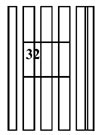 Increasingly important in everyday life is an understanding of data collection and display and basic statistical and probability ideas. Adults need to be comfortable interpreting graphs and tables and simple probability ideas, for example, what makes a sample random and which lottery ticket is the best bet. They also need to know when and how to use calculators appropriately. The use of calculators is no longer seen as the lazy way out; rather, there is recognition that the calculator, like the pencil, is a tool that allows the user to focus on the mathematical ideas that he or she is applying. Adult educators are generally familiar with new developments in verbal literacy, but often are not familiar with new approaches in numeracy instruction, frequently lacking a strong conceptual understanding of math themselves. As adult educators become more comfortable in these new domains, so will their students. Mathematics anxiety is best overcome when the subject begins to make sense. A good starting place for information is the National Council of Teachers of Mathematics website (www.nctm.org) or the website for the UNB Math Centre (www.unb.ca/education/MathCenter ). * Marian Small is Dean of Education and Professor of Mathematics Education at UNB; she has been at UNB for 28 years. She also serves as Director of the Math Centre, a professional development organization designed for N.B. teachers. Dr. Small has authored many elementary school, middle school, and high school texts used throughout Canada, the U.S., and Australia. She recently participated in a conference: Numeracy in 21st Century Canada: Current Challenges and Future Possibilities- A National Roundtable, sponsored by HRDC. |
| |
|
| Back | Next Page |
| |
|