

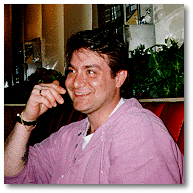
Don Locke has never backed down from a challenge. He lost an arm and a leg in 1971 when he was four years old. "That exposed me to prosthetics," he says.
Don is studying orthotics and prosthetics at George Brown College in Toronto.
Prosthetics is a branch of medicine. It deals with supplying artificial parts for the body. People who work in prosthetics are called prosthetists (pros*the*tists). Orthotics deals with making the artificial parts.
"The prosthetists at the Miller Centre are really the ones that talked me into doing this," says Don. "I had a lot of input into what was made for me. They told me I should really go to school and study it."
Don completed an upgrading course at CompuCollege in St. John's. Then he went to George Brown College. Don has been studying for two years. He will do on-the-job training this summer. After working for two years, Don will return to school for two more years.
"After June, I'll be a technician," he says. "A technician does the same work as a prosthetist. I'll be working in the background. I won't be dealing with people.
A prosthetist must study the same subjects as a doctor. "Biology is a must," he says. "We have to know exactly what a surgeon has to know."
Prosthetists make a lot of money. Don says that wasn't the reason he chose this career. "That's not why I'm into it," he says. "I know it might sound like a cliché. I would work tomorrow for nothing if I could. I really enjoy helping people. If I can make a difference in somebody else's life, it makes me all that much happier."
The word can't doesn't exist in Don's vocabulary. "There is no such word as can't to me," he says. "I don't know how people can use that word."
Don gets a lot of help from his family. He has never been told there isn't anything he can't do.
"I've got such a loving family," says Don. "They're so helpful, its almost scary. Whatever I do, they're there to push, push, push - not in a bad way. They're just there 110 per cent."