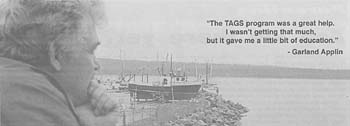
No choice as a Youth - work or starve Gar Applin is in his early fifties. He is the oldest child in a family of eleven children. Gar and his family live in Hawkes Bay on the Great Northern Peninsula. Gar says, "I spent most of my life fishing. I left home when I was 13 years old and went fishing as a shareman. I worked on draggers, gillnetters, and open boats." "I used to do carving -- soapstone and ivory -- years and years ago. I haven't done any of that now for 12 or 13 years. I got into the fishing and I was into that for close on 25 years." He says he wouldn't stay in Newfoundland "two days" if he could get a job. Gar didn't qualify for the TAGS program at first. He couldn't work and went on welfare. Gar says, "I never really worked in the workforce, only fishing. When you look for a job on land, it's hard, especially for me with no education or anything." Gar was later accepted for the TAGS program. Gar isn't on the TAGS program now. He says government, "should find a job for us or give us back our TAGS. It's a hard lookout for work around here now." Gar says the TAGS Program "was a great help. I wasn't getting that much, but it gave me a little bit of education. I couldn't read. I couldn't even write my own name when I went to Norpen in Port Saunders about two years ago. Now my wife writes out her grocery list and I can manage to go to the store. I can sit down and read a little novel or anything. I'm still into my books, trying to get a little more education." Today, Gar feels sorry for quitting school. He says, "I had no other choice. It was either go out to work or starve." He advises young people to stay in school and get their education. Always wanted to read, but couldn't Jane (not her real name) is 43 years old. She works as a seamstress in central Newfoundland. She worked in Toronto for 11 years. Then she went to work in a fish plant. Jane says, "I trimmed fish, I cut the fish, I washed the pans, I weighed it up." She was on the TAGS program until a couple of years ago. Jane was 14 years old when she left school. She says, "I wanted to go to work. I thought money was better than education." Jane went back to school in 1993. Jane says the TAGS Program has been a great help to her. She says, "If I never had the TAGS coming in I wouldn't have been able to go to school. It helped me learn how to read and write. That's something I always wanted to do. I'm very proud of that." Jane can read much better than she once did. She says, "I gotta read the patterns to cut the draperies out. Everything I pick up I read. I didn't do it before. Now I enjoy it. I read the Newfoundland Herald and stuff like that. I can take a book now and sit down and read it myself. I always wanted to do that before but I couldn't do it." Jane says, "I always felt left out because I couldn't read or write that good. I always felt like there was something missing. If someone handed me something, I couldn't read it. I used to pretend I was reading it, or I'd get out of the room before they could pass it to me. I went for a good many years and no one knew I couldn't read and write. When I was in school and I opened a book, it looked like dots to me. It meant nothing. I always wanted to know what them dots was. I got them dots figured out now." Jane's husband also upgraded his education under the TAGS Program. He now works as a paralegal. |
| PREVIOUS | TABLE OF CONTENTS | NEXT |