 |
|
The name Bonavista means "O'
Happy Sight." Seeing Newfoundland on June 26, 1497 must have
been a happy sight for John Cabot and his crew. The new Matthew
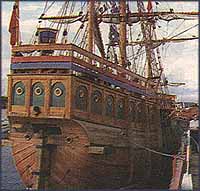
visited many communities this past summer. |
| Bonavista
|
June 24 - 26 |
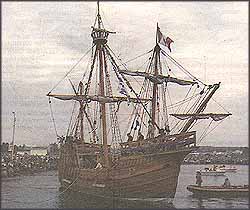
On June 24, The Matthew sailed into Bonavista. It is believed
that 30,000 people watched as The Matthew's crew docked in
Bonavista. There were many dignitaries on hand. They included Her
Majesty Queen Elizabeth the Second and Prince Phillip. Premier
Brian Tobin was also there.
The temperature was four degrees Celsius and a light drizzle
began falling as The Matthew entered port. The Queen welcomed
everyone to the festivities. She also dedicated the Ryan Premises.
These buildings are important in the history of Bonavista. This
Bonavista ceremony was the start of celebrations to mark the five
hundredth anniversary of John Cabot's discovery of Newfoundland.
John Cabot set sail from Bristol, England, on May 2, 1497. He
landed in Bonavista on June 26, 1497. |
| Gates Cove
|
June 27 |
It is believed that John Cabot was shipwrecked near Grates Cove
on his second voyage to Newfoundland in 1498. A four-day festival
celebrated this outport's ties to Cabot. The festivities featured
the traditional inshore fishery and local music and crafts. With
its rolling hills, Grates Cove was one of The Matthew's best
viewing sites. Grates Cove was also host to the Grates Cove Cabot
Rock Celebrations festival. |
| Harbour
Grace |
June 27 - 29 |
Harbour Grace celebrated Newfoundland's early years of doing
business. The town celebrated the days of pirates, fish merchants,
early airplane pilots and great shipping companies. Events
included a historic regatta, pirate battles and boat races. |
| St. John's
|
July 1 - 6 |
St. John's is the capital city of Newfoundland and Labrador. It
is also one of the oldest European settlements in North America.
Visitors also celebrated Canada's birthday on July 1. They
gathered at the city's waterfront. The first wireless message sent
across the Atlantic Ocean was sent from Signal Hill. This was also
the best location from which to see The Matthew as it came through
the narrows. Thousands of people visited the waterfront to
celebrate Canada Day and to tour The Matthew. Music, drama and
dance performances were held downtown. |
| Placentia
|
July 8 - 10 |
Placentia used to be the French capital of Newfoundland. This
town held many events to mark The Matthew's visit. The events
recalled Placentia's business and historic links with the
Portuguese, Basque, British, Irish and Americans. |
| Grand Bank
|
July 11 - 13 |
Grand Bank is named after the fishing grounds that made
Newfoundland famous. Grand Bank joined the French islands of St.
Pierre and Miquelon to celebrate the fishery. The islands of St.
Pierre and Miquelon can be found off the south coast of
Newfoundland. |
| Harbour
Breton |
July 13 - 14 |
The South Coast has many rolling hills and deep harbours. These
harbours were formed by glaciers. Harbour Breton celebrated The
Matthew's visit during its Summerfest. Summerfest is an historical
pageant and fish market exhibition. |
| Burgeo
|
July 15 - 16 |
The Matthew visited the people of Burgeo during their Sand and
Sea Festival. This festival included local boats and musical and
theatre acts. It also featured traditional southwest coast music
and community suppers. |
|
| Port Aux
Basques |
July 17 - 19 |
Port Aux Basques celebrated its history during Port Days. The
festivities were held at the Marine Atlantic lot. There were
concerts, tours, folk dances and a display of items found in the
waters off Isle aux Morts. |
| Stephenville
|
July 20 - 22 |
Stephenville is close to the Port au Port Peninsula. It is the
heart of French language and culture in Newfoundland. Stephenville
marked the five hundredth anniversary with many special acts.
These included Newfoundland's Acadian Village, the annual
Stephenville Musicfest and Drama Festival. These are some of the
best music and theatre events in Atlantic Canada. Stephenville was
also the site of giant lobster cook-outs, craft displays, special
hiking tours, boat races and fishing contests. |
| Corner
Brook |
July 23 - 26 |
Corner Brook is Newfoundland's second largest city. It was built
by the people who worked in the pulp and paper mill. The city's
Celebration of Summer honoured many famous explorers. It showed
the voyages of John Cabot, Jacques Cartier and Captain James Cook. |
| Red Bay
|
July 28 |
Basque whalers ran the first business in Newfoundland. This was
at Red Bay in the Sixteenth century. The whalers sold whale oil to
markets in Europe. Several thousand Labradorians gathered on the
shore at midnight to say goodbye to The Matthew. |
| St. Anthony
|
July 29 - 31 |
The first Europeans to visit Newfoundland were the Vikings. They
chose L'Anse Aux Meadows for their small settlement. That was
almost a thousand years ago. L'Anse Aux Meadows is near St.
Anthony. St. Anthony celebrated The Matthew and the "Spirit
of Discovery". There were Viking ceremonies and feasts. They
also honoured Sir Wilfred Grenfell, who was a doctor in northern
Newfoundland and Labrador. |
| La Scie
|
August 1 - 2 |
La Scie is an historic inshore fishing community located on the
Baie Verte Peninsula. It held Come Home Year festivities. The
people held community suppers, an old-fashioned concert and
fireworks. |
| Botwood
|
August 3 - 4 |
Botwood was the site of the world's first regular flight across
the Atlantic Ocean. This town celebrated The Matthew with
fireworks and music. It had one of the largest flotillas. |
| Twillingate
|
August 5 - 6 |
Twillingate has been an important fishing and business centre
since the 1730s. It is the home of the famous Fish, Fun and Folk
Festival. The town was made to look like an Eighteenth-century
fishing village. People wore clothing from those years. There were
flakes and splitting tables. A horse and buggy was used to drive
The Matthew's crew around town after they arrived. |
| Trinity
|
August 8 - 9 |
Trinity was one of Newfoundland's first settlements. This was
the final port of call for The Matthew. Europeans lived there
since 1501. The town is a National Heritage Community. Its history
was remembered through an open air pageant and theatre festival
that ran during the summer. |
|
Did You Know? |
|
The topsail is also known as the noddy sail because it looks
small and foolish above the huge main course.
There are nineteen crew members but only fourteen people can sit
around the table in the galley. |
|