 |
|
Who needs upgrading?
While interviewees report considerable confidence in their basic skills, it should be noted that most people identified by the International Adult Literacy Survey as having literacy challenges do not identify themselves as such. Thus the self-assessments of needs shown here may be overly optimistic. Almost identical proportions of women and men are categorized as having high needs, based on self-assessment. Younger respondents, and particularly those under 25, are less likely to be categorized as high needs than those who are older, particularly those 50 and over. Overall almost 40 per cent of our sample is included in one or more high needs group. The impact of years of schooling Differences in years of formal education do not seem to have a great impact. lnterviewees who left school at or before grade 8 are somewhat more likely to be included in high-need groups for reading or writing. But even here, those who report high needs are a minority: 16 per cent in the case of reading and 30 per cent in the case of writing. As for mathematics, formal education seems to make relatively little difference. Overall, just over 25 per cent of study participants report high needs in math. |
|
"I just want to get back to
school... I think I would take it more seriously now. You can't do nothing
without a grade 12." |
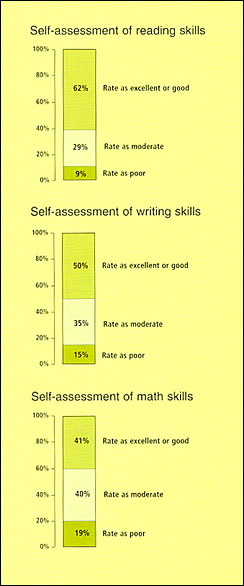 lnterviewees were asked to rate
separately, their reading, writing and mathematics skills as excellent, good,
moderate or poor. They were also asked if they ever sought help in any of these
areas, from friends, family or co-workers.
lnterviewees were asked to rate
separately, their reading, writing and mathematics skills as excellent, good,
moderate or poor. They were also asked if they ever sought help in any of these
areas, from friends, family or co-workers.| Previous Page | Table of Contents | Next Page |