| FIGURE 72 |
Prose Literacy * |
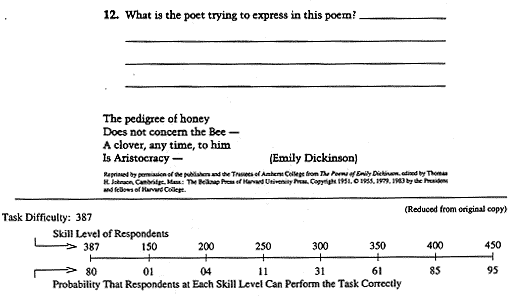
| Source: I. Kirsch and A Jungeblut.
(1986a) Literacy: Profiles of America's Young Adults. Princeton, NJ:
Educational Testing Service, National Assessment of Educational Progress.
(p.14) |
* This item was also used in the 1992 National
Adult Literacy Survey (NALS).
This item has a difficulty level of 387,
meaning that people must possess a skill level of 387 to have an 80%
probability of performing this task correctly. It is interesting to speculate
about why interpreting this poem, with only seventeen words, is more difficult
than the proceeding task about Tom Wicker's New York Times article. The latter
has several hundred words and numerous sentences. Yet it was easier for more
people to synthesize the main argument from Wicker's article than to say what
the poet was trying to express in the brief poem above. According to the YALS,
only 8.8 percent of the young adult population possessed Prose skill levels of
375 or above. So fewer than one in ten young adults would be expected to
perform the poetry interpretation task correctly. However, note that people
with a skill level of 350 have a 61% probability of performing the task, and
those at a skill level of 300 have a probability of 31 % of being able to
perform the task correctly. Thus, even though only fewer than ten percent of
the young adults are at the 375 level or above, more than that could be
expected to perform the task if the standard for performing correctly was set
lower than an 80% probability. For instance, if the standard for being defined
as possessing skills at a given level were set at 60%, then the poetry item
would be said to have a difficulty level of 350, and all those presently
scoring at the 350 level or above (21 percent of the young adults) would be
designated as possessing the skills for performing this task. This illustrates
that in the YALS study, whether one is below, at, or above a given skill level
depends upon the standard for performance that is established by the test
developers. In the absence of any compelling basis for establishing a standard,
any standard that is set is arbitrary. It represents a judgment about how good
is good enough to be called proficient at a given skill level.
|